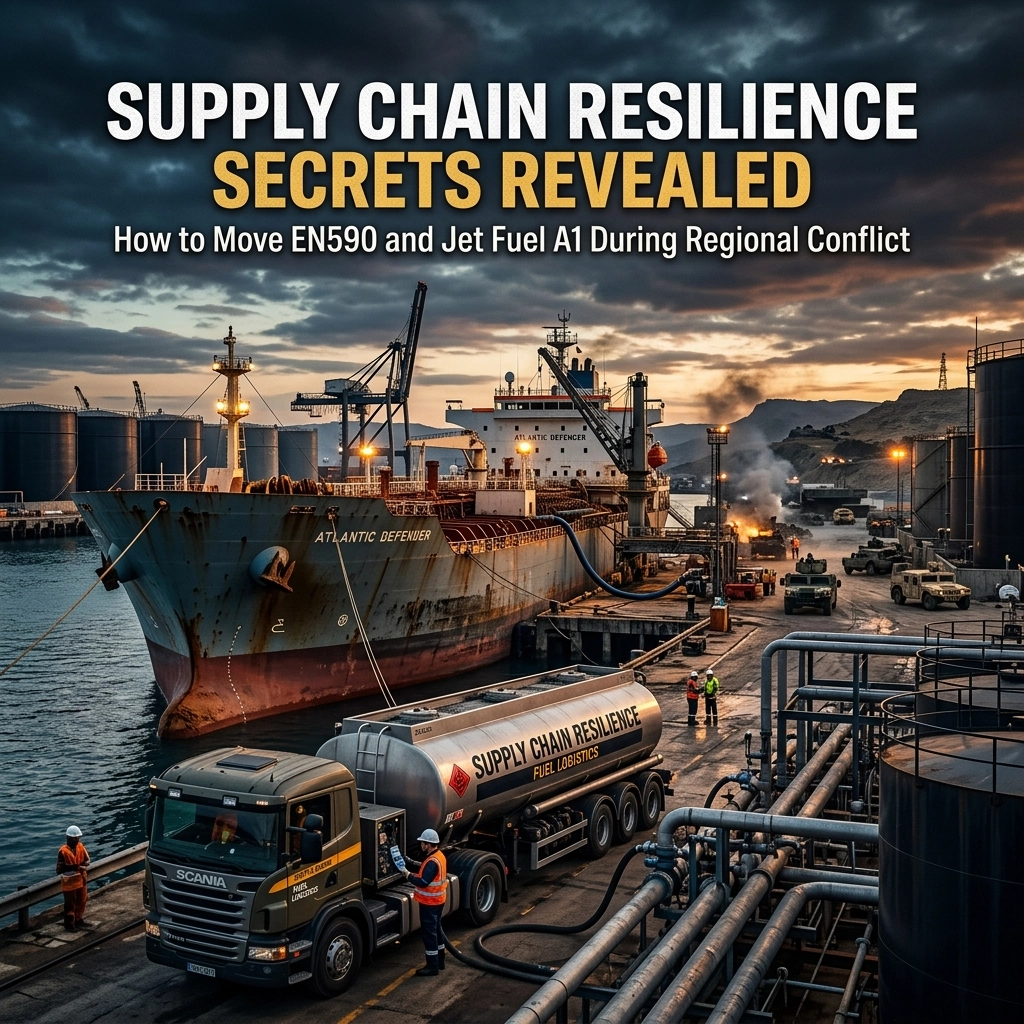
As of May 15, 2026, the global energy landscape is facing its most significant challenge in decades. The ongoing conflict in Iran has sent shockwaves through the petroleum markets, with the Strait of Hormuz experiencing a 70-80% collapse in commercial tanker traffic. For the modern fuel buyer, the primary concern is no longer just the price per metric ton, but the physical certainty of delivery.
In this climate, energy resilience isn't just a corporate buzzword; it is a survival requirement. Moving high-demand refined products like EN590, Jet Fuel A1, and D6 requires more than just a contract, it requires a battle-tested logistics network and an uncompromising approach to compliance. At Van Dyke Energy, we have refined the art of moving product through volatility, ensuring that our clients remain fueled while others are left stranded by broken supply chains.
The 2026 Energy Landscape: Navigating Regional Instability
The current regional instability in the Middle East has created a "perfect storm" for energy procurement. With major chokepoints restricted, the traditional routes for Jet Fuel A1 and EN590 have become high-risk zones. European jet fuel stocks have hit 6-year lows, and the reliance on external imports has never been more precarious.
When the Strait of Hormuz is compromised, the world loses immediate access to nearly 20% of its oil supply. For a fuel buyer, this means traditional sourcing strategies are obsolete. The "secrets" to resilience in 2026 lie in geographic diversification and the ability to pivot logistics in real-time. We are currently seeing a massive shift toward Western Hemisphere production and emerging African markets to fill the deficit left by Middle Eastern disruptions.

Secret #1: Geographic Diversification and "The Long Way Around"
The first secret to resilience is accepting that the shortest path is often the most dangerous. To ensure the delivery of Jet Fuel A1 and EN590, Van Dyke Energy has pioneered rerouting protocols that utilize the Cape of Good Hope. While this adds days to the transit time, it removes the catastrophic risk of seizure or destruction in high-conflict zones.
To mitigate the cost of these longer routes, we emphasize:
- Strategic Sourcing: Increasing allocations from US-based refineries and vetted Nigerian suppliers.
- Alternative Hubs: Utilizing safer trading hubs in the Atlantic and Pacific basins to bypass the Mediterranean and Gulf bottlenecks.
- Intermodal Flexibility: Shifting from large VLCCs (Very Large Crude Carriers) to smaller, more agile tankers that can access secondary ports with less congestion.
By diversifying where we pull product from, we ensure that a flare-up in one region does not result in a total supply cutoff for our clients.
Secret #2: Technical Adaptability – The Jet A vs. Jet A-1 Pivot
In times of conflict, rigid adherence to a single fuel grade can lead to grounded fleets. One of the industry’s best-kept secrets during the current 2026 crisis is the strategic substitution of Jet A (the US standard) for Jet Fuel A1 (the international standard).
While Jet Fuel A1 has a lower freezing point (-47°C) compared to Jet A (-40°C), many international routes can safely operate on Jet A with the correct technical oversight. Van Dyke Energy works closely with technical teams to implement fuel additives and freezing point monitoring, allowing our buyers to tap into the record-breaking US production levels when Middle Eastern A1 supplies are restricted. Understanding these technical nuances is a hallmark of true transparent fuel trading.
Secret #3: Vetting and Compliance in a "Shadow Market"
Regional conflict invariably gives rise to a "shadow market" of sanctioned goods. For a legitimate fuel buyer, the risk of accidentally engaging with sanctioned Iranian product is at an all-time high. A single compliance slip-up can lead to frozen assets, massive fines, and permanent reputational damage.
At Van Dyke Energy, our resilience is built on a foundation of rigorous vetting. We maintain a "whitelist" of non-sanctioned refineries and utilize third-party inspection firms (like SGS or Saybolt) at every transfer point. In today's climate, you must know exactly where your fuel originated. For more on this, we recommend reviewing our guide on sanctioned vs. non-sanctioned refineries.

The Importance of Financial Fortress: SBLCs and Top 50 Banks
Supply chain resilience is as much about financial security as it is about physical logistics. In 2026, many mid-tier banks are retreating from energy financing due to the perceived risk of the Iran conflict.
To move EN590 or Jet Fuel A1 successfully, transactions must be backed by Standby Letters of Credit (SBLC) from Top 50 Global Banks. These institutions have the liquidity and the international reach to ensure that payments are cleared even when regional banking systems are under stress. If your broker or supplier is asking for payment through obscure banks or via non-standard financial instruments, it is a massive red flag. Understanding why Top 50 global banks matter is essential for any serious buyer in the current market.
Red Flags: Protecting Yourself During a Crisis
When supply is tight, scammers proliferate. They prey on the desperation of buyers who need EN590 or D6 to keep their operations running. Beware of the following red flags in today's market:
- Unrealistic Pricing: If the price is significantly lower than the current Platts or Argus benchmarks despite the conflict, the product is either non-existent or sanctioned.
- Pressure to Skip Due Diligence: Any supplier rushing you to skip the Proof of Product (POP) phase is likely hiding a lack of title or product quality issues. Always verify what every fuel buyer should know about POP.
- Vague Logistics Plans: If a seller cannot tell you the specific vessel name, the current port of loading, or the exact route being taken to avoid conflict zones, they do not have control of the supply chain.

The Van Dyke Energy Advantage: Built for Volatility
At Van Dyke Energy, our logistics expertise is designed for the world as it is, not as we wish it to be. We recognize that the conflict in Iran has fundamentally changed the risk profile of refined fuel procurement. Our response has been to double down on our vetted network of suppliers and our relationships with global logistics giants.
We move EN590 for heavy industry, Jet Fuel A1 for aviation hubs, and D6 for power generation with a focus on three core pillars:
- Reliability: We only commit to volumes we can physically move.
- Compliance: Our KYC (Know Your Customer) and AML (Anti-Money Laundering) protocols are industry-leading.
- Transparency: We provide real-time updates on cargo movement and documentation.
In a market defined by uncertainty, the most valuable asset you can have is a partner who understands the logistics of resilience. Whether you are looking for long-term contract stability or urgent spot buys to fill a deficit, our team is equipped to navigate the complexities of the 2026 energy market.

Conclusion: Securing Your Future Supply
The secrets of supply chain resilience are not found in complex algorithms, but in the fundamentals of trade: vetted networks, technical adaptability, and financial integrity. As regional conflicts continue to reshape the global flow of energy, the divide between successful buyers and those facing shortages will be defined by their choice of partners.
Don't let regional instability dictate your operational success. Ensure your supply of EN590, Jet Fuel A1, and D6 remains uninterrupted by working with a team that specializes in high-stakes logistics.
For inquiries regarding current allocations and logistics solutions, please visit our Contact Page or explore our Buyer Procedures.
Mark Van Dyke
Sales Director, VanDykeEnergy.com
Reliability Powered by Trust.