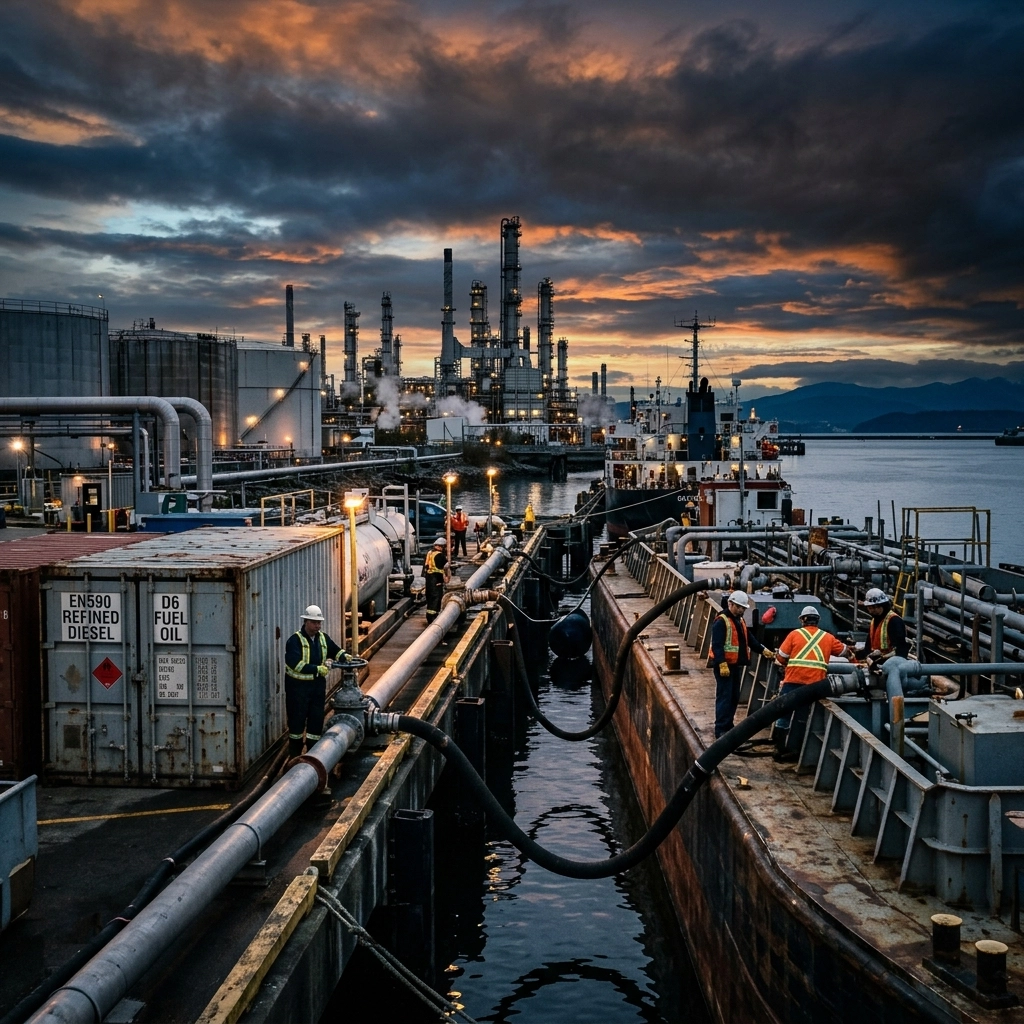
The global energy landscape in May 2026 has reached a definitive turning point. As regional instability in the Middle East: specifically the ongoing conflict involving Iran: continues to escalate, the "standard" operating procedures for fuel procurement have effectively evaporated. For the professional fuel buyer, the days of relying on a stable, predictable flow of refined products from the Persian Gulf are over.
This is not merely a temporary price spike. We are witnessing a fundamental restructuring of how EN590, Jet Fuel A1, and D6 are sourced, transported, and verified. To maintain energy resilience, companies must move beyond traditional brokers and look toward logistics-heavy partners who understand the new geography of oil. At Van Dyke Energy, we have spent years preparing for this level of market fragmentation, and we are now seeing those preparations become the standard for survival in the energy sector.
The Strait of Hormuz Bottleneck: A Structural Shift
The primary driver of this change is the vulnerability of the Strait of Hormuz. Historically, nearly 20% of the world’s liquid petroleum passed through this narrow waterway. However, the current conflict has rendered this route increasingly unreliable. For producers of EN590 and D6, the impact is twofold: the physical blockage of tankers and the scarcity of the specific medium-heavy crude grades required for diesel refining.
Nearly 60% of crude exports from the Persian Gulf are medium-heavy grades. These are the essential feedstocks for high-quality diesel. When this supply is choked, refineries in Asia and Europe cannot simply "switch" to lighter crudes without significant loss in efficiency and volume. This has led to a global deficit in refined products that cannot be solved by simply increasing production elsewhere.

Why Traditional Refineries are Closing Their Doors to Exports
In response to the instability, major refining hubs in South Korea, China, and parts of the Mediterranean have begun to implement export restrictions. These nations are prioritizing domestic energy security over international trade. If you are a buyer currently waiting on a cargo from a traditional "Tier 1" refinery in the East, you may find that your contract is being invoked under force majeure clauses more frequently than ever before.
This shift makes it imperative to understand the distinction between various supply sources. Navigating the market today requires a deep understanding of sanctioned vs non-sanctioned refineries. As supply tightens, the "grey market" becomes more active, and the risk of accidentally entering into a transaction involving sanctioned Iranian or Russian molecules increases exponentially. The legal and financial repercussions in 2026 are too severe to ignore; compliance is no longer a department: it is a survival strategy.
The Logistical Pivot: Sourcing EN590 and Jet Fuel A1 in 2026
With traditional routes compromised, Van Dyke Energy has pivoted toward non-traditional logistics pathways. We are seeing a record number of diesel and Jet Fuel A1 cargoes originating from the U.S. Gulf Coast and reaching markets that were previously dominated by Middle Eastern supply.
This logistical shift requires more than just "finding fuel." It requires:
- Vetted Networks: Our network consists only of refineries and title holders that pass rigorous third-party audits.
- Global Transit Expertise: Moving fuel through secondary ports and utilizing smaller, more agile tanker fleets to avoid high-risk zones.
- Financial Fortitude: The ability to secure product using robust financial instruments. Understanding why top 50 global banks matter in fuel trade is critical when the cost of a single D6 cargo can fluctuate by millions of dollars in a single trading session.

Red Flags for the Modern Fuel Buyer: Avoiding Scams in Scarcity
Whenever there is regional instability and supply scarcity, bad actors flood the market. They take advantage of the desperation felt by buyers who need to fuel their fleets or maintain their power grids. In today's climate, if a deal looks too good to be true, it is likely a fraudulent attempt or a sanctioned product disguised as compliant fuel.
Common Red Flags in the Current Market:
- Proof of Product (POP) Ambiguity: If a seller cannot provide verifiable, time-stamped Proof of Product, walk away. You should know exactly what every fuel buyer should know about POP before signing any ICPO.
- Unusual Payment Demands: Requests for upfront fees, "insurance" payments, or transfers to non-standard banking jurisdictions are immediate signs of fraud.
- Lack of Past Performance: In a crisis, only those with a track record of successful deliveries matter. Ask for redacted Bill of Ladings or SGS reports from the last 90 days.
At Van Dyke Energy, we eliminate these risks by implementing a transparent, multi-step verification process. We ensure that every drop of EN590 or D6 we move is fully compliant and physically present.

Strategic Procurement: Building Energy Resilience
To thrive in this new era of energy trade, procurement officers must stop thinking like shoppers and start thinking like strategists. Energy resilience is built on diversification and reliability, not just the lowest price per gallon.
One of the 7 mistakes you're making with EN590 diesel procurement is relying on a single geographic source. By spreading your procurement across multiple jurisdictions and utilizing a partner like Van Dyke Energy: who maintains relationships across both hemispheres: you insulate your operations from the shocks of the Iran conflict.
Furthermore, the RFP (Request for Proposal) process has become the gold standard for high-volume transactions. A structured RFP allows you to vet sellers on more than just price; it allows you to evaluate their logistics capabilities, their compliance frameworks, and their financial stability.

Van Dyke Energy: Reliability Powered by Trust
The conflict in Iran has fundamentally changed the "physics" of the fuel market. The momentum has shifted from those who own the most oil to those who can most reliably move it and verify it. Jet Fuel A1, EN590, and D6 are still available, but the gates are guarded by complexity and risk.
Van Dyke Energy stands as a bridge over this instability. Our logistics expertise allows us to bypass regional volatility, ensuring that our clients' operations never go dark. Whether you are fueling a national airline or an industrial manufacturing hub, you need a partner who views geopolitical conflict as a logistical problem to be solved, not an insurmountable barrier.
As we navigate the remainder of 2026, the successful fuel buyers will be those who prioritize compliance, vetted networks, and logistics-first partnerships. The Iran conflict is a wake-up call; it is time to rebuild your supply chain for the reality of the modern world.

Key Takeaways for 2026 Procurement:
- Diversify Sourcing: Move away from heavy reliance on the Persian Gulf.
- Prioritize Logistics: Ensure your supplier has a proven path to market that avoids conflict zones.
- Enforce Compliance: Rigorously vet every refinery and title holder to avoid sanctioned products.
- Verify Everything: Use only top-tier banking instruments and demand clear Proof of Product.
The market is changing. Van Dyke Energy is leading the way.
Mark Van Dyke
Sales Director, VanDykeEnergy.com
Reliability Powered by Trust.