
Author: 810467pwpadmin

  • How to Secure EN590 and Jet Fuel A1 Supplies During the Iran Conflict

    How to Secure EN590 and Jet Fuel A1 Supplies During the Iran Conflict

    In today's climate, the global energy landscape is facing its most significant stress test in decades. As of May 2026, the ongoing conflict in Iran and the resulting near-standstill of traffic through the Strait of Hormuz have sent shockwaves through the middle-distillate markets. For any serious fuel buyer, the priority has shifted from price optimization to pure energy resilience and supply certainty.

    With approximately 20-25% of the world’s oil and petroleum products normally transiting this critical chokepoint, the partial closure has effectively removed millions of barrels of EN590 diesel and Jet Fuel A1 from the immediate reach of European and Asian markets. At Van Dyke Energy, we are seeing a dramatic increase in "panic buying," yet the seasoned procurement teams know that panic is the enemy of compliance. Securing fuel in 2026 requires a sophisticated understanding of alternative logistics, non-sanctioned sourcing, and a vetted network that operates outside the immediate conflict zone.

    The Hormuz Bottleneck: Why Middle Distillates are Most at Risk

    The current disruption is not merely a "crude oil problem." While crude prices have hovered near $100/bbl, the real crisis lies in the refined product sector. Regional refineries in Bahrain, Qatar, and the UAE: traditional powerhouses for Jet Fuel A1 and EN590: have been forced to reduce utilization or halt exports entirely due to the maritime blockade.

    This has created a physical shortage in the Atlantic and Pacific basins. Europe, which had already pivoted away from Russian supply, now finds its secondary source in the Middle East severed. Consequently, EN590 spot prices are experiencing unprecedented volatility. In this environment, the ability to pivot to refineries in the US Gulf Coast, Rotterdam, and Singapore is no longer a luxury; it is a necessity for operational survival.

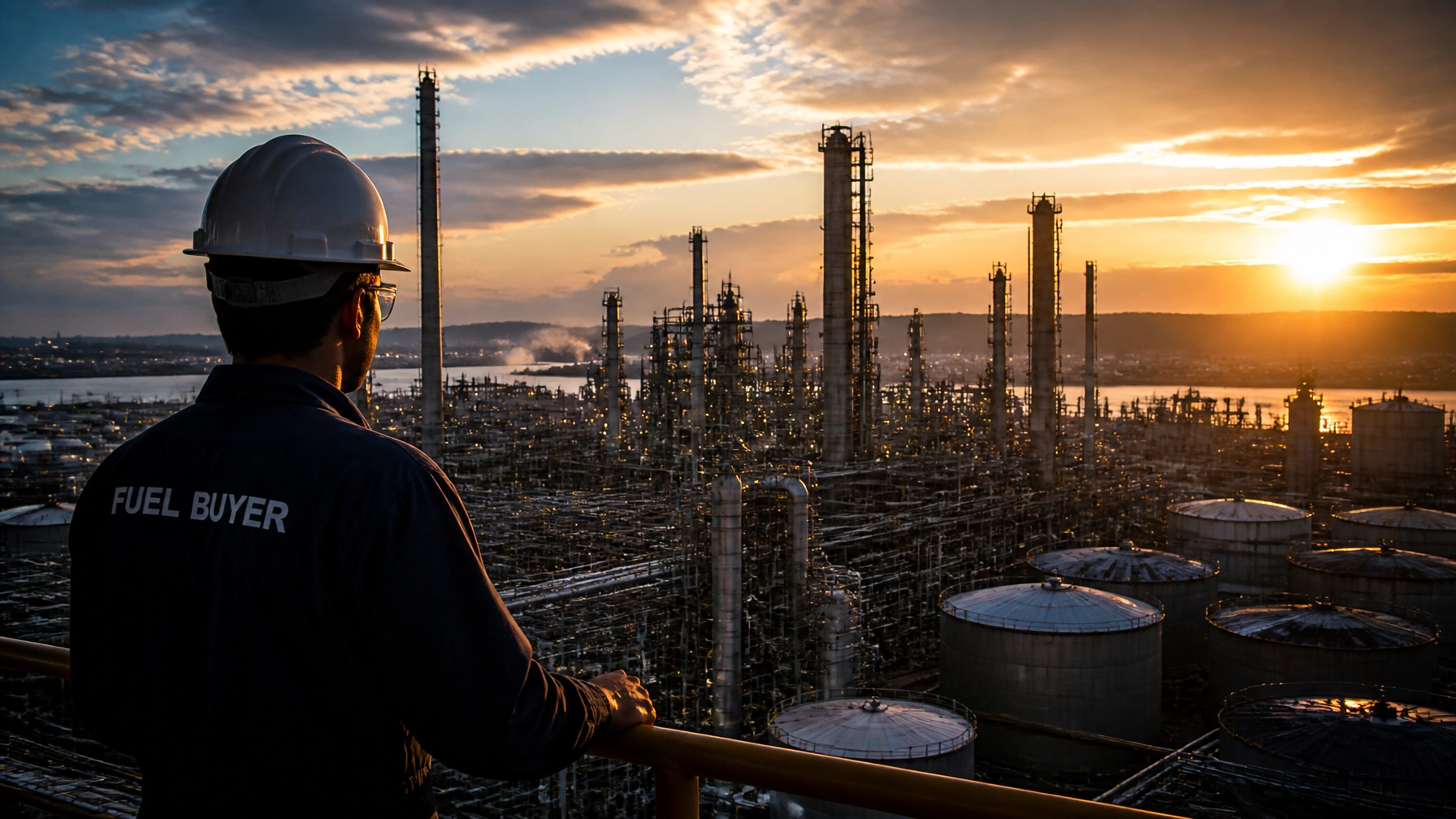
    A large-scale oil refinery illuminated at dusk, representing the backbone of Van Dyke Energy’s refined fuels supply chain.

    Navigating the Scramble: Red Flags and Market Risks

    When supply tightens, the number of "ghost" sellers and fraudulent mandates increases exponentially. We are seeing a surge in offers for "discounted" EN590 that supposedly originated from the Gulf but is now "stuck" in transit. In today's market, if a deal looks too good to be true, it is likely a compliance nightmare waiting to happen.

    Critical Red Flags for Fuel Buyers in 2026:

    1. Unusually Deep Discounts: Real EN590 and Jet A1 are trading at a premium due to scarcity. Offers at $50-$100 below PLATTs are almost certainly fraudulent or involve sanctioned product.
    2. Pressure to Bypass Procedures: Scammers will use the "urgency of the conflict" to skip standard SGS inspections or Proof of Product (POP) verification. Never waive these requirements.
    3. Ambiguous Origin Documentation: With the Strait of Hormuz blocked, you must be hyper-vigilant about the chain of custody. Ensure you are not inadvertently purchasing fuel from sanctioned refineries, which can lead to severe legal and financial penalties.
    4. Requests for Upfront "Logistics Fees": Legitimate sellers and brokers like Van Dyke Energy operate on structured, performance-based procedures. Upfront payments for "shipping insurance" or "port fees" are a hallmark of procurement scams.

    For a deeper dive into avoiding these pitfalls, refer to our guide on 7 mistakes you're making with EN590 diesel procurement.

    The Van Dyke Strategy: Global Logistics and Vetted Networks

    Securing a consistent supply of Jet Fuel A1 and EN590 during regional instability requires a global footprint. We maintain strategic relationships with refineries and mandates in non-conflict zones, ensuring that our clients' supply chains remain uninterrupted.

    Our logistics expertise allows us to manage both FOB (Freight on Board) and CIF (Cost, Insurance, and Freight) transactions across major trading hubs including Houston, Fujairah, and Singapore. While Fujairah remains a key hub, its proximity to the conflict zone means we are increasingly rerouting deliveries through alternative corridors to mitigate risk.

    A digital world map highlighting Van Dyke Energy’s global network of buyers, sellers, and trading hubs.

    Our 2026 Compliance Framework:

    • Rigorous Vetting: Every seller in our network undergoes a multi-layered due diligence process to ensure they have the physical capacity to deliver.
    • SGS/Intertek Verification: We mandate third-party inspections at every critical junction to verify quantity and quality (Q&Q).
    • Banking Transparency: We work exclusively with Top 50 global banks to handle SBLCs (Standby Letters of Credit) and DLCs (Documentary Letters of Credit), providing financial security for both parties. Understanding why top global banks matter in fuel trade is essential for any modern buyer.

    Securing Your Supply: FOB vs. CIF in Conflict Zones

    The choice between FOB and CIF has never been more consequential. In a conflict-heavy environment, CIF (Cost, Insurance, and Freight) is often preferred by buyers who want the seller to assume the transit risk until the product reaches a safe port. However, with skyrocketing insurance premiums in the Middle East, FOB (Freight on Board) from stable hubs like Rotterdam or Houston is becoming the more cost-effective and reliable method.

    By taking title to the product at the loading port, buyers gain more control over the shipping route and can choose carriers that are not on "high-risk" lists. Van Dyke Energy assists buyers in navigating these choices, ensuring that the Proof of Product (POP) is verified before any financial instruments are activated.

    A compliance manager reviewing energy contracts, highlighting Van Dyke Energy’s commitment to structured and compliant transactions.

    Building Long-Term Energy Resilience

    Spot deals are useful for immediate needs, but the 2026 conflict proves that offtake agreements are the only way to ensure long-term stability. Buyers should be looking to secure 12-to-60-month contracts for EN590 and Jet A1 now, before the full weight of the supply shortage is felt across the industrial and aviation sectors.

    Airlines and logistics firms that fail to secure their Jet Fuel A1 procurement today will find themselves at the mercy of a volatile spot market tomorrow. We recommend a "layered" approach: 70% offtake for baseline operations and 30% spot to capitalize on occasional market dips.

    Direct Actions for Fuel Buyers

    The window for "wait and see" has closed. If your organization relies on middle distillates, you should take the following steps immediately:

    1. Audit Your Supply Chain: Identify any dependencies on refineries located within the Gulf region or shipping routes passing through Hormuz.
    2. Diversify Your Port of Entry: If you usually take delivery in Asia, look at West Coast US or Singaporean allocations to bypass the Indian Ocean bottlenecks.
    3. Engage a Verified Broker: Stop chasing LinkedIn "mandates" with generic Gmail addresses. Work with a firm that has a proven track record of reliability.
    4. Prepare Your Financials: Ensure your banking facilities are ready to issue MT760 or MT700 instruments from a Tier 1 bank. In a tight market, sellers will prioritize buyers who can demonstrate immediate financial capability.

    A mission-critical fuel delivery tanker at night, symbolizing Van Dyke Energy’s capability for urgent fuel delivery.

    Conclusion: Reliability Powered by Trust

    The Iran conflict of 2026 is a harsh reminder that the global fuel market is fragile. However, for those who move with speed, precision, and strict adherence to compliance, it is still possible to secure the EN590, Jet Fuel A1, and D6 required to keep the world moving. At Van Dyke Energy, we don't just find fuel; we build the logistical and financial bridges that allow transactions to close in even the most volatile conditions.

    If you are a qualified fuel buyer ready to secure your next allocation, contact us today to discuss our available supply and procedures.

    Mark Van Dyke
    Sales Director, VanDykeEnergy.com
    Reliability Powered by Trust.

  • Energy Resilience Matters: How Every Fuel Buyer Can Protect Their Supply Chain Amidst the Iran Conflict

    Energy Resilience Matters: How Every Fuel Buyer Can Protect Their Supply Chain Amidst the Iran Conflict

    In today’s climate, energy resilience is no longer a strategic advantage: it is a requirement for survival. As we move through May 2026, the ongoing conflict in Iran has fundamentally reshaped the global energy landscape, pushing crude prices toward historic highs and creating unprecedented volatility in the refined products market. For the fuel buyer, the stakes have never been higher. The traditional reliance on "business as usual" procurement has collapsed under the weight of maritime blockades and geopolitical uncertainty.

    At Van Dyke Energy, we have observed a critical shift in how Jet Fuel A1, EN590, and D6 are traded and transported. Reliability is now measured not just in price per barrel, but in the certainty of delivery and the robustness of the underlying supply chain.

    The Chokepoint Crisis: Why the Strait of Hormuz Matters to You

    The Strait of Hormuz remains the world’s most sensitive energy artery. With nearly 20% of global LNG and 30% of global oil flows facing potential or actual disruption, the "Hormuz Premium" has become a permanent fixture in pricing models. While the news often focuses on crude, the impact on middle distillates like EN590 (Ultra-Low Sulfur Diesel) and Jet Fuel A1 is even more acute.

    European and Asian markets, which are structurally short on diesel, have seen their traditional supply routes through the Gulf challenged. This has forced a massive rerouting of tankers around the Cape of Good Hope, adding weeks to transit times and significantly increasing freight and insurance costs. For a fuel buyer, this means that "spot" deals are increasingly rare and incredibly risky.

    Navigating the Scarcity of EN590 and Jet Fuel A1

    Middle distillates are currently the most stressed segment of the refinery pool. As global supply chains tighten, refiners are struggling to balance the competing demands for heating oil, transport diesel, and aviation fuel.

    1. EN590 (Diesel 10PPM): With the reduction of Gulf exports, Europe is pulling heavily on Atlantic Basin supplies. This has created a "bidding war" for barrels coming out of the US Gulf Coast and India.
    2. Jet Fuel A1: The aviation sector is particularly vulnerable. Major hubs in Singapore, Rotterdam, and Houston are seeing localized inventory draws that threaten flight schedules and operational stability.
    3. D6 Fuel Oil: Heavy industrial users are finding it increasingly difficult to secure long-term offtake agreements as refineries prioritize lighter, higher-margin distillates.

    A large-scale oil refinery illuminated at dusk, representing Van Dyke Energy's backbone of refined fuels supply.

    Red Flags: Avoiding Scams in a Distressed Market

    In times of crisis, the "paper traders" and scammers emerge in force. A desperate fuel buyer is an easy target. We are seeing a surge in fraudulent offers claiming to have "immediate stock" in Rotterdam or Houston at pre-conflict prices. The reality is that if a price looks too good to be true in 2026, it is almost certainly a scam.

    Watch for these critical Warning Signs:

    • Non-Bankable Proof of Product (POP): If a seller cannot provide verifiable, bank-to-bank POP, walk away. Understanding what every fuel buyer should know about POP is the first line of defense against fraud.
    • Upfront Fee Requests: Any demand for "administrative fees" or "vessel handling fees" before a standard SGS inspection and Title Transfer is a massive red flag.
    • Sanctioned Origins: With the Iran conflict, there is a heightened risk of sanctioned barrels being "laundered" through third-party transfers. Ensure your provider understands the difference between sanctioned vs. non-sanctioned refineries to avoid catastrophic legal and financial repercussions.
    • Vague Logistics Plans: Reliable sellers will provide specific tank farm details or vessel names that can be tracked. Vague references to "imminent arrival" are usually smoke screens.

    Building Energy Resilience through Vetted Networks

    The only way to ensure energy resilience is to work with a partner who possesses a deeply vetted, global network of mandates and refineries. At Van Dyke Energy, we do not just broker deals; we engineer logistics solutions that bypass regional instability.

    Our approach focuses on FOB (Free on Board) and CIF (Cost, Insurance, and Freight) deliveries to major, safe-water trading hubs. By diversifying our sourcing across the US Gulf Coast, Brazil, and compliant Asian refiners, we ensure that our clients are not overly exposed to a single geographical chokepoint.

    The Importance of Global Banking in Fuel Trade

    In a high-risk environment, the financial instrument is as important as the fuel itself. Transactions involving Jet Fuel A1 or EN590 require the backing of top-tier financial institutions. This is why we emphasize that Top 50 global banks matter in fuel trade; without an SBLC (Standby Letter of Credit) or DLC (Documentary Letter of Credit) from a recognized bank, your transaction is unlikely to close.

    A digital world map highlighting Van Dyke Energy's interconnected global network of oil and fuel buyers.

    Van Dyke Energy: Your Partner in a Volatile World

    Van Dyke Energy specializes in connecting qualified buyers with certified sellers across international energy markets. Our advantage lies in our transparency and execution certainty. We support FOB and CIF deliveries to major hubs including Houston, Rotterdam, Fujairah, and Singapore, backed by rigorous SGS inspection and compliance protocols.

    In the current 2026 landscape, we provide the clarity needed to move forward. We understand that a fuel buyer is not just looking for a product; they are looking for a guarantee that their operations will not grind to a halt.

    Our Core Commitments to Reliability:

    • Rigorous Compliance: Every seller in our network undergoes an exhaustive vetting process to ensure they meet international standards and are free from sanction risks.
    • Logistics Expertise: We handle the complexities of moving EN590 and Jet Fuel A1 worldwide, managing the shifting insurance requirements and freight volatility caused by the Iran conflict.
    • Strategic Sourcing: By leveraging our relationships with both major refineries and niche producers, we find supply where others see only shortages.

    For those struggling with current procurement challenges, it is worth reviewing our guide on 7 mistakes you’re making with EN590 diesel procurement to refine your strategy.

    A compliance manager reviewing energy contracts, highlighting Van Dyke Energy's commitment to structured transactions.

    Strategic Recommendations for 2026

    If you are a fuel buyer navigating this conflict, we recommend the following actions to protect your supply chain:

    1. Move Toward Long-Term Offtake: Spot market volatility is currently too high for stable budgeting. Secure your baseline needs with 12-to-24-month offtake agreements.
    2. Audit Your Supply Chain Origins: Ensure you have full visibility into where your fuel is refined. Avoid any middleman who cannot provide a clear chain of custody.
    3. Prioritize Logistics Flexibility: Be prepared to take delivery in alternative hubs. If Rotterdam is congested or overpriced, consider Houston or Singapore as part of a diversified strategy.
    4. Strengthen Banking Relationships: Ensure your bank is ready to issue the necessary instruments quickly. Speed of execution is often the difference between securing a cargo and losing it to a competitor.

    Conclusion: The Path Forward

    The conflict in Iran has proven that the global energy market is fragile, but not unnavigable. Energy resilience is built on the foundation of trust, compliance, and logistical agility. By moving away from high-risk, "too-good-to-be-true" offers and focusing on vetted, transparent supply chains, fuel buyers can protect their operations from the shocks of 2026 and beyond.

    At Van Dyke Energy, we remain committed to being the anchor in this storm, providing the speed, integrity, and clarity your business requires.

    Mark Van Dyke
    Sales Director, VanDykeEnergy.com
    Reliability Powered by Trust.
  • Energy Resilience Matters: How Fuel Buyers Secure EN590 and Jet Fuel A1 During the Iran Conflict

    Energy Resilience Matters: How Fuel Buyers Secure EN590 and Jet Fuel A1 During the Iran Conflict

    In today's climate, the global energy market is no longer a predictable machine. As of May 2026, the escalating Iran conflict has transformed a projected crude oil surplus into a high-stakes arena of volatility and supply-chain fragility. For the serious fuel buyer, the mission has shifted from simple procurement to a rigorous exercise in energy resilience.

    When the Strait of Hormuz: a chokepoint responsible for nearly 20% of global oil consumption: becomes a theater of geopolitical tension, the ripple effects are felt instantly in the refined products market. While crude prices capture the headlines, the real battle for stability is happening in the EN590 diesel and Jet Fuel A1 sectors. At Van Dyke Energy, we are seeing a dramatic shift in how institutional buyers and national procurement teams approach their offtake agreements. Reliability is no longer assumed; it is engineered through vetted networks and ironclad compliance.

    The Hormuz Paradox: Why Refined Products Are the New Front Line

    While Brent crude volatility is a known factor, the current conflict has created a "Hormuz Paradox." Even if crude remains available through pipeline bypasses in Saudi Arabia or the UAE, the middle distillate market: specifically EN590 10ppm and Jet A1: is facing a disproportionate squeeze.

    The Iranian sector accounts for a significant portion of regional refined product exports. A disruption here doesn’t just remove barrels; it removes complex refining capacity. For European buyers, this is a critical threat. Europe remains structurally short on diesel and aviation fuel, relying heavily on imports from Middle Eastern refineries that are now within the conflict's "red zone."

    Energy resilience in 2026 requires moving beyond the traditional Gulf-centric supply model. Buyers should be looking toward Atlantic Basin alternatives and established hubs in Kazakhstan, Oman, and the US Gulf Coast to mitigate the risk of a total Hormuz closure.

    refinery-dusk

    EN590 Scarcity: Protecting the Industrial Backbone

    EN590 diesel is the lifeblood of European logistics and industrial operations. In the current conflict environment, we are seeing crack spreads widen to historic levels. The cost of refining a barrel of crude into ultra-low sulfur diesel (ULSD) has spiked because the logistics of moving that diesel have become perilous.

    Regional Supply Blowouts

    In Northwest Europe and Mediterranean hubs, premiums for EN590 are hitting record highs. This is driven by two factors:

    1. Reduced Feedstock: European refineries are struggling to secure the specific crude grades required for high-yield diesel production.
    2. Import Choke: Traditional routes from the Middle East are being diverted around the Cape of Good Hope, adding weeks to delivery times and thousands to freight costs.

    Buyers must understand that FOB Rotterdam or FOB Houston positions are now more valuable than ever. Securing a dependable supply chain means locking in allocations from refineries that are geographically removed from the immediate conflict zone.

    Jet Fuel A1: Navigating the Aviation Logistics Crisis

    The aviation sector is perhaps the most sensitive to regional instability. Jet Fuel A1 logistics are under immense pressure as military operations in the region consume vast quantities of fuel, further tightening the available supply for commercial operators.

    Airlines and FBOs are currently facing a dual challenge: rerouting and refueling. As flight paths are diverted to avoid conflict airspace, fuel consumption per flight increases, while the supply at key regional hubs becomes uncertain.

    Logistics flexibility is the only solution. Successful fuel buyers are currently prioritizing CIF (Cost, Insurance, and Freight) deliveries to secure ports, ensuring that the risk of transit is managed by experienced maritime partners. At Van Dyke Energy, we leverage our vetted international network to ensure that Jet A1 reaches its destination, even when traditional shipping lanes are contested.

    global-network

    Red Flags: Avoiding the "Paper Barrel" Trap in Volatile Markets

    High volatility always attracts bad actors. In the current market, "paper barrels" (offers for fuel that does not exist or cannot be delivered) are at an all-time high. Every fuel buyer must be on high alert for the following red flags:

    • Unrealistic Discounting: If an offer for EN590 or Jet A1 is significantly below the current Platts benchmark despite the Iran conflict, it is almost certainly a scam.
    • Proof of Product (POP) Ambiguity: Sellers who refuse to provide verifiable POP or hesitate to engage in SGS inspection protocols are a major risk.
    • Sanctioned Origins: With the Iran conflict, there is an influx of "grey market" fuel. Buyers must conduct rigorous KYC/AML verification to ensure they are not inadvertently funding sanctioned entities.
    • Non-Standard Procedures: Avoid sellers who demand large upfront "administrative fees" or "shipping deposits" outside of standard escrow or SBLC (Standby Letter of Credit) structures.

    Warning: The risk of reputational and legal damage from dealing with sanctioned or non-existent fuel is far greater than the potential savings of a "too-good-to-be-true" deal.

    The Van Dyke Energy Strategy: Vetted Compliance and Strategic Sourcing

    In a conflict-driven market, Van Dyke Energy provides the clarity and certainty that institutional buyers require. Our approach to energy resilience is built on three pillars:

    1. Rigorous Vetting

    We don't just broker deals; we broker trust. Every seller in our network: from refineries in the US to mandates in Kazakhstan: undergoes a comprehensive audit. We ensure that the fuel you buy is non-sanctioned, SGS-verified, and legally exportable. This is the cornerstone of our compliance-first mentality.

    2. Diversified Logistics

    We recognize that the Iran conflict has made certain routes untenable. Our logistics teams work with freight forwarders and shipping agents to arrange end-to-end delivery, utilizing alternative routes and secure trading hubs like Rotterdam, Houston, and Singapore. Whether it's a spot transaction or a 12-month offtake agreement, we prioritize execution certainty.

    3. Structured Transactions

    We facilitate transactions through standard industrial financial instruments (MT103, SBLC, DLC). This protects both the buyer and the seller, ensuring that payment only flows when the product is verified and the title is ready for transfer.

    compliance-manager

    Building a Resilient Fuel Portfolio for 2026 and Beyond

    Securing EN590 and Jet Fuel A1 during a regional war requires a proactive strategy. Waiting for the market to "cool down" is not an option for critical infrastructure or commercial aviation. To build resilience, fuel buyers should:

    • Diversify Origin Points: Do not rely solely on Middle Eastern exports. Seek allocations from the US Gulf Coast, West Africa, and Southeast Asia.
    • Prioritize Relationship over Price: In a crisis, a long-term contract with a trusted partner is worth more than a slightly cheaper spot deal from an unknown source.
    • Optimize Inventory Levels: Maintain higher-than-average operational stocks to buffer against short-term shipping delays or sudden port closures.
    • Leverage Expert Brokerage: Use a partner like Van Dyke Energy to navigate the complex web of compliance, logistics, and refinery relations.

    Conclusion: Reliability Powered by Trust

    The Iran conflict of 2026 has redefined the energy landscape. It has proven that energy resilience is not just about having a supplier; it’s about having a vetted, compliant, and flexible supply chain. For the modern fuel buyer, the path forward is clear: emphasize verification, demand transparency, and never sacrifice compliance for a shortcut.

    At Van Dyke Energy, we bring speed, integrity, and clarity to every deal. We are here to ensure that your operations keep moving, no matter how volatile the global stage becomes.

    Are you ready to secure your fuel supply? Contact Van Dyke Energy today to speak with our procurement specialists.

    night-port

    Mark Van Dyke
    Sales Director, VanDykeEnergy.com
    Reliability Powered by Trust.

  • The Ultimate Guide to Energy Resilience: Navigating Global Fuel Markets During the Iran Conflict

    A massive oil tanker navigating dark, turbulent waters at twilight, representing energy resilience.

    In today's climate, the global energy landscape is facing its most significant challenge in decades. As of May 19, 2026, the ongoing conflict in the Middle East has moved beyond regional instability and into a full-scale disruption of the world's most critical energy arteries. With the Strait of Hormuz effectively restricted, the ripple effects are being felt in every major trading hub from Rotterdam to Singapore. For the sophisticated fuel buyer, the priority has shifted from simple procurement to a rigorous focus on energy resilience.

    The current volatility is not merely a matter of price spikes: though Brent crude repeatedly testing levels above $100 per barrel is a stark reality: it is a matter of execution certainty. In a market where supply chains are being rerouted and refining capacities are strained, partnering with a provider that possesses deep-seated logistics expertise is the only way to maintain operational continuity. Van Dyke Energy remains at the forefront of this effort, leveraging a vetted global network to ensure that critical refined fuels like EN590 diesel and Jet Fuel A1 reach their destinations despite the geopolitical headwinds.

    The Hormuz Bottleneck: A Middle Distillate Crisis

    The restriction of the Strait of Hormuz has removed approximately 20% of global oil supply from the immediate market. While the headlines often focus on crude, the real "pinch point" for industrial and aviation sectors is the availability of middle distillates.

    EN590 10ppm diesel and Jet Fuel A1 are currently in a state of physical tightness that has not been seen since the post-2022 energy realignment. Europe, which had already transitioned away from Russian supply, is now facing a dual-threat: the loss of Middle Eastern flows and the increased cost of shipping via longer, alternative routes.

    Large-scale oil refinery illuminated at dusk, representing the backbone of the refined fuels supply chain.

    Key Market Disruption Factors:

    • Freight and Insurance Premiums: War risk premiums have skyrocketed, adding significant ton-mile costs to any cargo originating near the Gulf.
    • Refinery Yield Shifts: Global refineries are struggling to balance output. While some are maximizing middle distillate yields to meet the surge in demand, the lack of spare capacity means that spot availability remains critically low.
    • Backwardation Risks: The futures curve for diesel is in deep backwardation, making the holding of inventory prohibitively expensive. Buyers must now rely on just-in-time delivery from trusted sources rather than localized stockpiling.

    Navigating Volatility with Van Dyke Energy

    In an environment where "force majeure" has become a common phrase, Van Dyke Energy has maintained its commitment to transparency and delivery. Our advantage lies in our ability to bypass regional chokepoints by tapping into our strategic relationships with non-Hormuz dependent refineries. We focus on sourcing from the U.S. Gulf Coast, West Africa, and select Asian hubs that remain insulated from the immediate conflict zone.

    Whether you are managing an airline fleet requiring consistent Jet Fuel A1 or an industrial operation dependent on EN590 diesel, the strategy for 2026 must be built on diversified sourcing. We provide structured, compliant transactions that mitigate the risks of today's volatile market.

    Strategic Logistics and Global Reach

    Van Dyke Energy supports both FOB and CIF deliveries to major trading hubs. By utilizing a network of mandates and institutional buyers, we ensure that every transaction is backed by SGS inspection and rigorous compliance protocols. In a high-stakes environment, our ability to move fuel worldwide: backed by actual proof of product (POP): is what separates a successful transaction from a costly failure.

    An intricate network of industrial pipes and valves in a refinery at night, showing the complexity of fuel management.

    Red Flags: Avoiding Scams in a High-Risk Market

    High volatility always attracts opportunistic and fraudulent actors. During the current Iran conflict, we have seen a sharp increase in "ghost cargoes" and fraudulent documentation. As a professional fuel buyer, you must be vigilant.

    Critical Warnings and Industry Red Flags:

    1. Too-Good-To-Be-True Pricing: If a seller is offering EN590 or Jet Fuel A1 at significant discounts relative to the current Platt’s benchmarks during a global shortage, it is likely a scam. Market prices are high for a reason; no legitimate refinery is "giving away" product in 2026.
    2. Unverified Proof of Product (POP): Never accept a POP without a verifiable bank-to-bank communication or a fresh SGS report. Understanding what every fuel buyer should know about POP is essential to protecting your capital.
    3. Ambiguous Sanction Compliance: With the Iran conflict, the risk of "tainted" or sanctioned oil entering the secondary market is high. Van Dyke Energy employs strict sanctioned vs. non-sanctioned refinery vetting to ensure all product is fully compliant with international law.
    4. Pressure for Upfront Fees: Standard industry procedures typically involve SBLCs or DLCs from top-tier banks. Avoid any seller demanding upfront "logistics fees" or "insurance costs" before the financial instrument is operative.

    Digital world map with interconnected points representing a global network of energy trade.

    Energy Resilience through Compliance

    Reliability in the energy sector is powered by trust and transparency. At Van Dyke Energy, our compliance protocols are designed to protect both the buyer and the seller. In today's market, having a compliance manager review every federal and international contract is not a luxury: it is a necessity.

    We specialize in connecting verified buyers with certified sellers through a structured RFP process. This ensures that all parties have the financial capacity and the physical product necessary to complete the trade. By focusing on Top 50 global banks for SBLCs, we provide a level of financial security that is paramount during periods of geopolitical upheaval.

    Compliance manager reviewing energy contracts and logistics dashboards at a refinery desk.

    The Forward-Looking Perspective: Fuel Sourcing in late 2026

    As we look toward the second half of 2026, energy resilience will continue to be the defining metric of success for global enterprises. The conflict in Iran has permanently altered shipping routes and refinery priorities. Buyers should typically expect higher base prices but can mitigate this through long-term offtake agreements that lock in supply volumes.

    EN590 and Jet Fuel A1 supply chains are evolving. We are seeing a move toward more AI-driven logistics optimization to manage the complexities of rerouted tankers. Van Dyke Energy is leading this charge, ensuring that our clients are never left vulnerable to the "pinch points" of the traditional energy market.

    Execution is Everything

    Whether you are performing a spot transaction in Houston or a long-term offtake in Singapore, the fundamentals of the deal must be sound. Avoid the common mistakes made in EN590 procurement by working with a partner that understands the nuances of international fuel law and the realities of maritime logistics.

    A fuel tanker truck travels efficiently at night, representing global connectivity and delivery standards.

    Conclusion: Securing Your Energy Future

    The Iran conflict has demonstrated that the global energy market is both fragile and remarkably adaptable. For those who understand how to navigate the complexities of refined fuel logistics, the current crisis presents an opportunity to build a more resilient and diversified supply chain.

    Van Dyke Energy remains dedicated to delivering speed, integrity, and clarity to every transaction. Our vetted network and deep industry expertise allow us to provide execution certainty in a world where certainty is a rare commodity. We do not just move fuel; we power the reliability your business depends on.

    Mark Van Dyke
    Sales Director, VanDykeEnergy.com
    Reliability Powered by Trust.

  • The Ultimate Guide to Energy Resilience: Securing D6 and Refined Fuels Amid the Iran Conflict

    The Ultimate Guide to Energy Resilience: Securing D6 and Refined Fuels Amid the Iran Conflict

    [HERO] The Ultimate Guide to Energy Resilience: Securing D6 and Refined Fuels Amid the Iran Conflict

    In the current geopolitical landscape of May 2026, the global energy market is facing its most significant challenge in decades. The ongoing conflict in Iran has transcended regional borders, creating a ripple effect that threatens the stability of refined fuel supplies across every continent. For the modern fuel buyer, the priority has shifted from simple procurement to a sophisticated strategy of energy resilience.

    The Strait of Hormuz, a critical artery for global oil, remains a point of extreme volatility. With nearly 20% of the world’s liquid petroleum passing through this narrow passage, any disruption isn't just an "oil problem": it is a catastrophic supply chain event for refined products like EN590, Jet Fuel A1, and D6 Virgin Fuel Oil. As traditional routes become high-risk zones, the ability to secure molecules depends entirely on logistics expertise and a vetted network of non-sanctioned origins.

    The Shift from Crude to Refined Product Vulnerability

    While the media often focuses on crude oil prices, the real crisis for industrial and aviation sectors lies in refined product availability. The conflict has seen targeted strikes on regional refineries and storage hubs, causing "crack spreads" to reach historic highs.

    For those operating in the aviation sector, Jet Fuel A1 has become increasingly difficult to move through traditional channels. Similarly, the agricultural and transport sectors relying on EN590 (10PPM Diesel) are seeing a tightening of supply as European and Asian refineries struggle to compensate for Middle Eastern shortfalls.

    Van Dyke Energy has anticipated these disruptions. By leveraging a global logistics framework that bypasses primary conflict zones, we ensure that our clients maintain operational continuity. Resilience in 2026 means moving beyond "just-in-time" delivery and embracing a "just-in-case" infrastructure.

    refinery-operations-at-dusk.webp

    Understanding the D6 Challenge: Heavy Fuel Oil vs. Financial Instruments

    In today's market, the term "D6" is often used loosely, but for the serious fuel buyer, it refers to Virgin Fuel Oil D6. This heavy residual fuel is the lifeblood of large-scale power generation, marine engines, and industrial boilers.

    Securing D6 amid the Iran conflict requires more than just a contract; it requires logistics hardening. Because D6 is highly viscous and requires specialized heating for storage and transport, the destruction of regional infrastructure has made it one of the hardest fuels to source reliably.

    Why D6 Sourcing is High-Risk Right Now:

    • Infrastructure Damage: Regional storage tanks for heavy fuels are primary targets in conflict zones.
    • Shipping Bottlenecks: Many Tier-1 tankers are refusing to enter the Gulf, leading to a massive shortage of "dirty" tankers capable of carrying D6.
    • Compliance Minefields: Distinguishing between sanctioned and non-sanctioned heavy fuel has become a full-time job for legal departments.

    For guidance on navigating these legal complexities, we recommend reviewing our analysis on sanctioned vs. non-sanctioned refineries.

    Energy Resilience: A Strategic Framework for 2026

    To achieve true energy resilience, fuel buyers must move away from a single-source mindset. The Iran conflict has proven that geographic concentration is the enemy of stability.

    1. Diversify Origin Points

    Do not rely on a single refinery or even a single region. Van Dyke Energy maintains a vetted network of suppliers in the US Gulf Coast, West Africa, and Southeast Asia. By spreading your procurement across different geopolitical zones, you insulate your operations from localized conflict.

    2. Lock in Term Contracts

    The spot market is currently a playground for speculators and scammers. In a time of war, a term contract with a reliable partner provides volume protection. Spot deals for EN590 or Jet Fuel A1 are increasingly subject to "Force Majeure" cancellations. A term agreement ensures you are a priority customer when allocations are restricted.

    3. Verify Your Logistics

    A contract is only as good as the ship carrying the fuel. Van Dyke Energy’s logistics expertise allows us to re-route shipments in real-time. If a specific port of entry becomes compromised, our network of freight forwarders and vessel owners provides the flexibility to divert cargo to safer terminals.

    global-network-connectivity.webp

    The Role of Compliance and Banking in Fuel Procurement

    In a high-volatility environment, the "paper trail" becomes your shield. Financial institutions are under increased pressure to ensure that no funds are inadvertently supporting sanctioned entities or conflict participants. This is why we emphasize the importance of working with Top 50 Global Banks and utilizing instruments like the Standby Letter of Credit (SBLC).

    Working with secondary or tertiary banks during a regional war is a massive red flag. These institutions are often the first to have their liquidity frozen or their correspondent banking relationships severed. For a deeper dive into why your choice of bank dictates your fuel security, see our post on why Top 50 global banks matter in fuel trade.

    Red Flags to Watch For:

    • Off-Market Pricing: If the price for Jet Fuel A1 is significantly below the Platts benchmark during a conflict, the fuel is likely either non-existent or of sanctioned origin.
    • Complex Intermediary Chains: Every extra broker in the chain is a point of failure and a potential compliance risk.
    • Lack of Proof of Product (POP): In 2026, transparency is non-negotiable. If a seller cannot provide verifiable POP, walk away. Learn more about what every fuel buyer should know about POP.

    How Van Dyke Energy Secures Your Supply Chain

    At Van Dyke Energy, we don't just facilitate trades; we engineer supply chain solutions. Our approach to the Iran conflict is rooted in proactive risk mitigation. We utilize a vetted network of refineries and logistics providers that have been audited for both quality and compliance.

    compliance-manager-reviewing-energy-contracts-refinery-desk.webp

    Our expertise in EN590 and Jet Fuel A1 logistics means we understand the technical nuances of these products: from flash points to sulfur content: and the specific regulatory hurdles of different international ports. We handle the complexity so that your mission-critical operations never run dry.

    Whether you are fueling a national airline or a massive industrial complex, our reliability is powered by trust. We navigate the sanctions, the shipping lanes, and the shifting geopolitical sands so you don't have to.

    Moving Forward: The Fuel Buyer RFP Process

    In this climate, we encourage serious buyers to engage in a structured Request for Proposal (RFP) process. This allows for a transparent exchange of requirements and capabilities, ensuring that both parties are aligned on compliance and delivery schedules.

    fuel-buyer-rfp-badge.webp

    The era of "casual" fuel trading is over. The Iran conflict has ushered in a period where only the most professional, compliant, and logistically sound operators will thrive. To begin securing your energy future, visit our buyers page or contact us directly.

    Conclusion: Security Through Expertise

    Energy resilience is not a luxury; it is a necessity for survival in the 2026 market. By understanding the risks associated with D6, EN590, and Jet Fuel A1, and by partnering with an organization that prioritizes logistics and compliance, you can navigate the current instability with confidence.

    The conflict may be ongoing, but your supply chain doesn't have to be a casualty. Trust the experts who move the world’s fuel, even when the world is in turmoil.

    Mark Van Dyke
    Sales Director, VanDykeEnergy.com
    Reliability Powered by Trust.

  • Supply Chain Resilience Secrets Revealed: How to Move EN590 and Jet Fuel A1 During Regional Conflict

    Supply Chain Resilience Secrets Revealed: How to Move EN590 and Jet Fuel A1 During Regional Conflict

    As of May 15, 2026, the global energy landscape is facing its most significant challenge in decades. The ongoing conflict in Iran has sent shockwaves through the petroleum markets, with the Strait of Hormuz experiencing a 70-80% collapse in commercial tanker traffic. For the modern fuel buyer, the primary concern is no longer just the price per metric ton, but the physical certainty of delivery.

    In this climate, energy resilience isn't just a corporate buzzword; it is a survival requirement. Moving high-demand refined products like EN590, Jet Fuel A1, and D6 requires more than just a contract, it requires a battle-tested logistics network and an uncompromising approach to compliance. At Van Dyke Energy, we have refined the art of moving product through volatility, ensuring that our clients remain fueled while others are left stranded by broken supply chains.

    The 2026 Energy Landscape: Navigating Regional Instability

    The current regional instability in the Middle East has created a "perfect storm" for energy procurement. With major chokepoints restricted, the traditional routes for Jet Fuel A1 and EN590 have become high-risk zones. European jet fuel stocks have hit 6-year lows, and the reliance on external imports has never been more precarious.

    When the Strait of Hormuz is compromised, the world loses immediate access to nearly 20% of its oil supply. For a fuel buyer, this means traditional sourcing strategies are obsolete. The "secrets" to resilience in 2026 lie in geographic diversification and the ability to pivot logistics in real-time. We are currently seeing a massive shift toward Western Hemisphere production and emerging African markets to fill the deficit left by Middle Eastern disruptions.

    Refinery operations at dusk showcasing the backbone of the fuel supply chain

    Secret #1: Geographic Diversification and "The Long Way Around"

    The first secret to resilience is accepting that the shortest path is often the most dangerous. To ensure the delivery of Jet Fuel A1 and EN590, Van Dyke Energy has pioneered rerouting protocols that utilize the Cape of Good Hope. While this adds days to the transit time, it removes the catastrophic risk of seizure or destruction in high-conflict zones.

    To mitigate the cost of these longer routes, we emphasize:

    • Strategic Sourcing: Increasing allocations from US-based refineries and vetted Nigerian suppliers.
    • Alternative Hubs: Utilizing safer trading hubs in the Atlantic and Pacific basins to bypass the Mediterranean and Gulf bottlenecks.
    • Intermodal Flexibility: Shifting from large VLCCs (Very Large Crude Carriers) to smaller, more agile tankers that can access secondary ports with less congestion.

    By diversifying where we pull product from, we ensure that a flare-up in one region does not result in a total supply cutoff for our clients.

    Secret #2: Technical Adaptability – The Jet A vs. Jet A-1 Pivot

    In times of conflict, rigid adherence to a single fuel grade can lead to grounded fleets. One of the industry’s best-kept secrets during the current 2026 crisis is the strategic substitution of Jet A (the US standard) for Jet Fuel A1 (the international standard).

    While Jet Fuel A1 has a lower freezing point (-47°C) compared to Jet A (-40°C), many international routes can safely operate on Jet A with the correct technical oversight. Van Dyke Energy works closely with technical teams to implement fuel additives and freezing point monitoring, allowing our buyers to tap into the record-breaking US production levels when Middle Eastern A1 supplies are restricted. Understanding these technical nuances is a hallmark of true transparent fuel trading.

    Secret #3: Vetting and Compliance in a "Shadow Market"

    Regional conflict invariably gives rise to a "shadow market" of sanctioned goods. For a legitimate fuel buyer, the risk of accidentally engaging with sanctioned Iranian product is at an all-time high. A single compliance slip-up can lead to frozen assets, massive fines, and permanent reputational damage.

    At Van Dyke Energy, our resilience is built on a foundation of rigorous vetting. We maintain a "whitelist" of non-sanctioned refineries and utilize third-party inspection firms (like SGS or Saybolt) at every transfer point. In today's climate, you must know exactly where your fuel originated. For more on this, we recommend reviewing our guide on sanctioned vs. non-sanctioned refineries.

    Compliance manager reviewing energy contracts to ensure regulatory adherence

    The Importance of Financial Fortress: SBLCs and Top 50 Banks

    Supply chain resilience is as much about financial security as it is about physical logistics. In 2026, many mid-tier banks are retreating from energy financing due to the perceived risk of the Iran conflict.

    To move EN590 or Jet Fuel A1 successfully, transactions must be backed by Standby Letters of Credit (SBLC) from Top 50 Global Banks. These institutions have the liquidity and the international reach to ensure that payments are cleared even when regional banking systems are under stress. If your broker or supplier is asking for payment through obscure banks or via non-standard financial instruments, it is a massive red flag. Understanding why Top 50 global banks matter is essential for any serious buyer in the current market.

    Red Flags: Protecting Yourself During a Crisis

    When supply is tight, scammers proliferate. They prey on the desperation of buyers who need EN590 or D6 to keep their operations running. Beware of the following red flags in today's market:

    1. Unrealistic Pricing: If the price is significantly lower than the current Platts or Argus benchmarks despite the conflict, the product is either non-existent or sanctioned.
    2. Pressure to Skip Due Diligence: Any supplier rushing you to skip the Proof of Product (POP) phase is likely hiding a lack of title or product quality issues. Always verify what every fuel buyer should know about POP.
    3. Vague Logistics Plans: If a seller cannot tell you the specific vessel name, the current port of loading, or the exact route being taken to avoid conflict zones, they do not have control of the supply chain.

    Global network connectivity map illustrating Van Dyke Energy's reach

    The Van Dyke Energy Advantage: Built for Volatility

    At Van Dyke Energy, our logistics expertise is designed for the world as it is, not as we wish it to be. We recognize that the conflict in Iran has fundamentally changed the risk profile of refined fuel procurement. Our response has been to double down on our vetted network of suppliers and our relationships with global logistics giants.

    We move EN590 for heavy industry, Jet Fuel A1 for aviation hubs, and D6 for power generation with a focus on three core pillars:

    • Reliability: We only commit to volumes we can physically move.
    • Compliance: Our KYC (Know Your Customer) and AML (Anti-Money Laundering) protocols are industry-leading.
    • Transparency: We provide real-time updates on cargo movement and documentation.

    In a market defined by uncertainty, the most valuable asset you can have is a partner who understands the logistics of resilience. Whether you are looking for long-term contract stability or urgent spot buys to fill a deficit, our team is equipped to navigate the complexities of the 2026 energy market.

    Fuel tanker truck traveling at night representing secure and timely delivery

    Conclusion: Securing Your Future Supply

    The secrets of supply chain resilience are not found in complex algorithms, but in the fundamentals of trade: vetted networks, technical adaptability, and financial integrity. As regional conflicts continue to reshape the global flow of energy, the divide between successful buyers and those facing shortages will be defined by their choice of partners.

    Don't let regional instability dictate your operational success. Ensure your supply of EN590, Jet Fuel A1, and D6 remains uninterrupted by working with a team that specializes in high-stakes logistics.

    For inquiries regarding current allocations and logistics solutions, please visit our Contact Page or explore our Buyer Procedures.

    Mark Van Dyke
    Sales Director, VanDykeEnergy.com
    Reliability Powered by Trust.

  • Supply Chain Resilience Secrets Revealed: How to Move EN590 and Jet Fuel A1 During Regional Conflict

    Supply Chain Resilience Secrets Revealed: How to Move EN590 and Jet Fuel A1 During Regional Conflict

    As of May 15, 2026, the global energy landscape is facing its most significant challenge in decades. The ongoing conflict in Iran has sent shockwaves through the petroleum markets, with the Strait of Hormuz experiencing a 70-80% collapse in commercial tanker traffic. For the modern fuel buyer, the primary concern is no longer just the price per metric ton, but the physical certainty of delivery.

    In this climate, energy resilience isn't just a corporate buzzword; it is a survival requirement. Moving high-demand refined products like EN590, Jet Fuel A1, and D6 requires more than just a contract, it requires a battle-tested logistics network and an uncompromising approach to compliance. At Van Dyke Energy, we have refined the art of moving product through volatility, ensuring that our clients remain fueled while others are left stranded by broken supply chains.

    The 2026 Energy Landscape: Navigating Regional Instability

    The current regional instability in the Middle East has created a "perfect storm" for energy procurement. With major chokepoints restricted, the traditional routes for Jet Fuel A1 and EN590 have become high-risk zones. European jet fuel stocks have hit 6-year lows, and the reliance on external imports has never been more precarious.

    When the Strait of Hormuz is compromised, the world loses immediate access to nearly 20% of its oil supply. For a fuel buyer, this means traditional sourcing strategies are obsolete. The "secrets" to resilience in 2026 lie in geographic diversification and the ability to pivot logistics in real-time. We are currently seeing a massive shift toward Western Hemisphere production and emerging African markets to fill the deficit left by Middle Eastern disruptions.

    Refinery operations at dusk showcasing the backbone of the fuel supply chain

    Secret #1: Geographic Diversification and "The Long Way Around"

    The first secret to resilience is accepting that the shortest path is often the most dangerous. To ensure the delivery of Jet Fuel A1 and EN590, Van Dyke Energy has pioneered rerouting protocols that utilize the Cape of Good Hope. While this adds days to the transit time, it removes the catastrophic risk of seizure or destruction in high-conflict zones.

    To mitigate the cost of these longer routes, we emphasize:

    • Strategic Sourcing: Increasing allocations from US-based refineries and vetted Nigerian suppliers.
    • Alternative Hubs: Utilizing safer trading hubs in the Atlantic and Pacific basins to bypass the Mediterranean and Gulf bottlenecks.
    • Intermodal Flexibility: Shifting from large VLCCs (Very Large Crude Carriers) to smaller, more agile tankers that can access secondary ports with less congestion.

    By diversifying where we pull product from, we ensure that a flare-up in one region does not result in a total supply cutoff for our clients.

    Secret #2: Technical Adaptability – The Jet A vs. Jet A-1 Pivot

    In times of conflict, rigid adherence to a single fuel grade can lead to grounded fleets. One of the industry’s best-kept secrets during the current 2026 crisis is the strategic substitution of Jet A (the US standard) for Jet Fuel A1 (the international standard).

    While Jet Fuel A1 has a lower freezing point (-47°C) compared to Jet A (-40°C), many international routes can safely operate on Jet A with the correct technical oversight. Van Dyke Energy works closely with technical teams to implement fuel additives and freezing point monitoring, allowing our buyers to tap into the record-breaking US production levels when Middle Eastern A1 supplies are restricted. Understanding these technical nuances is a hallmark of true transparent fuel trading.

    Secret #3: Vetting and Compliance in a "Shadow Market"

    Regional conflict invariably gives rise to a "shadow market" of sanctioned goods. For a legitimate fuel buyer, the risk of accidentally engaging with sanctioned Iranian product is at an all-time high. A single compliance slip-up can lead to frozen assets, massive fines, and permanent reputational damage.

    At Van Dyke Energy, our resilience is built on a foundation of rigorous vetting. We maintain a "whitelist" of non-sanctioned refineries and utilize third-party inspection firms (like SGS or Saybolt) at every transfer point. In today's climate, you must know exactly where your fuel originated. For more on this, we recommend reviewing our guide on sanctioned vs. non-sanctioned refineries.

    Compliance manager reviewing energy contracts to ensure regulatory adherence

    The Importance of Financial Fortress: SBLCs and Top 50 Banks

    Supply chain resilience is as much about financial security as it is about physical logistics. In 2026, many mid-tier banks are retreating from energy financing due to the perceived risk of the Iran conflict.

    To move EN590 or Jet Fuel A1 successfully, transactions must be backed by Standby Letters of Credit (SBLC) from Top 50 Global Banks. These institutions have the liquidity and the international reach to ensure that payments are cleared even when regional banking systems are under stress. If your broker or supplier is asking for payment through obscure banks or via non-standard financial instruments, it is a massive red flag. Understanding why Top 50 global banks matter is essential for any serious buyer in the current market.

    Red Flags: Protecting Yourself During a Crisis

    When supply is tight, scammers proliferate. They prey on the desperation of buyers who need EN590 or D6 to keep their operations running. Beware of the following red flags in today's market:

    1. Unrealistic Pricing: If the price is significantly lower than the current Platts or Argus benchmarks despite the conflict, the product is either non-existent or sanctioned.
    2. Pressure to Skip Due Diligence: Any supplier rushing you to skip the Proof of Product (POP) phase is likely hiding a lack of title or product quality issues. Always verify what every fuel buyer should know about POP.
    3. Vague Logistics Plans: If a seller cannot tell you the specific vessel name, the current port of loading, or the exact route being taken to avoid conflict zones, they do not have control of the supply chain.

    Global network connectivity map illustrating Van Dyke Energy's reach

    The Van Dyke Energy Advantage: Built for Volatility

    At Van Dyke Energy, our logistics expertise is designed for the world as it is, not as we wish it to be. We recognize that the conflict in Iran has fundamentally changed the risk profile of refined fuel procurement. Our response has been to double down on our vetted network of suppliers and our relationships with global logistics giants.

    We move EN590 for heavy industry, Jet Fuel A1 for aviation hubs, and D6 for power generation with a focus on three core pillars:

    • Reliability: We only commit to volumes we can physically move.
    • Compliance: Our KYC (Know Your Customer) and AML (Anti-Money Laundering) protocols are industry-leading.
    • Transparency: We provide real-time updates on cargo movement and documentation.

    In a market defined by uncertainty, the most valuable asset you can have is a partner who understands the logistics of resilience. Whether you are looking for long-term contract stability or urgent spot buys to fill a deficit, our team is equipped to navigate the complexities of the 2026 energy market.

    Fuel tanker truck traveling at night representing secure and timely delivery

    Conclusion: Securing Your Future Supply

    The secrets of supply chain resilience are not found in complex algorithms, but in the fundamentals of trade: vetted networks, technical adaptability, and financial integrity. As regional conflicts continue to reshape the global flow of energy, the divide between successful buyers and those facing shortages will be defined by their choice of partners.

    Don't let regional instability dictate your operational success. Ensure your supply of EN590, Jet Fuel A1, and D6 remains uninterrupted by working with a team that specializes in high-stakes logistics.

    For inquiries regarding current allocations and logistics solutions, please visit our Contact Page or explore our Buyer Procedures.

    Mark Van Dyke
    Sales Director, VanDykeEnergy.com
    Reliability Powered by Trust.

  • Why the Iran Conflict Will Change the Way You Source EN590 and D6 Refined Fuels

    Why the Iran Conflict Will Change the Way You Source EN590 and D6 Refined Fuels

    The global energy landscape in May 2026 has reached a definitive turning point. As regional instability in the Middle East: specifically the ongoing conflict involving Iran: continues to escalate, the "standard" operating procedures for fuel procurement have effectively evaporated. For the professional fuel buyer, the days of relying on a stable, predictable flow of refined products from the Persian Gulf are over.

    This is not merely a temporary price spike. We are witnessing a fundamental restructuring of how EN590, Jet Fuel A1, and D6 are sourced, transported, and verified. To maintain energy resilience, companies must move beyond traditional brokers and look toward logistics-heavy partners who understand the new geography of oil. At Van Dyke Energy, we have spent years preparing for this level of market fragmentation, and we are now seeing those preparations become the standard for survival in the energy sector.

    The Strait of Hormuz Bottleneck: A Structural Shift

    The primary driver of this change is the vulnerability of the Strait of Hormuz. Historically, nearly 20% of the world’s liquid petroleum passed through this narrow waterway. However, the current conflict has rendered this route increasingly unreliable. For producers of EN590 and D6, the impact is twofold: the physical blockage of tankers and the scarcity of the specific medium-heavy crude grades required for diesel refining.

    Nearly 60% of crude exports from the Persian Gulf are medium-heavy grades. These are the essential feedstocks for high-quality diesel. When this supply is choked, refineries in Asia and Europe cannot simply "switch" to lighter crudes without significant loss in efficiency and volume. This has led to a global deficit in refined products that cannot be solved by simply increasing production elsewhere.

    Van Dyke Energy Globe Graphic

    Why Traditional Refineries are Closing Their Doors to Exports

    In response to the instability, major refining hubs in South Korea, China, and parts of the Mediterranean have begun to implement export restrictions. These nations are prioritizing domestic energy security over international trade. If you are a buyer currently waiting on a cargo from a traditional "Tier 1" refinery in the East, you may find that your contract is being invoked under force majeure clauses more frequently than ever before.

    This shift makes it imperative to understand the distinction between various supply sources. Navigating the market today requires a deep understanding of sanctioned vs non-sanctioned refineries. As supply tightens, the "grey market" becomes more active, and the risk of accidentally entering into a transaction involving sanctioned Iranian or Russian molecules increases exponentially. The legal and financial repercussions in 2026 are too severe to ignore; compliance is no longer a department: it is a survival strategy.

    The Logistical Pivot: Sourcing EN590 and Jet Fuel A1 in 2026

    With traditional routes compromised, Van Dyke Energy has pivoted toward non-traditional logistics pathways. We are seeing a record number of diesel and Jet Fuel A1 cargoes originating from the U.S. Gulf Coast and reaching markets that were previously dominated by Middle Eastern supply.

    This logistical shift requires more than just "finding fuel." It requires:

    1. Vetted Networks: Our network consists only of refineries and title holders that pass rigorous third-party audits.
    2. Global Transit Expertise: Moving fuel through secondary ports and utilizing smaller, more agile tanker fleets to avoid high-risk zones.
    3. Financial Fortitude: The ability to secure product using robust financial instruments. Understanding why top 50 global banks matter in fuel trade is critical when the cost of a single D6 cargo can fluctuate by millions of dollars in a single trading session.

    Refinery Operations at Dusk

    Red Flags for the Modern Fuel Buyer: Avoiding Scams in Scarcity

    Whenever there is regional instability and supply scarcity, bad actors flood the market. They take advantage of the desperation felt by buyers who need to fuel their fleets or maintain their power grids. In today's climate, if a deal looks too good to be true, it is likely a fraudulent attempt or a sanctioned product disguised as compliant fuel.

    Common Red Flags in the Current Market:

    • Proof of Product (POP) Ambiguity: If a seller cannot provide verifiable, time-stamped Proof of Product, walk away. You should know exactly what every fuel buyer should know about POP before signing any ICPO.
    • Unusual Payment Demands: Requests for upfront fees, "insurance" payments, or transfers to non-standard banking jurisdictions are immediate signs of fraud.
    • Lack of Past Performance: In a crisis, only those with a track record of successful deliveries matter. Ask for redacted Bill of Ladings or SGS reports from the last 90 days.

    At Van Dyke Energy, we eliminate these risks by implementing a transparent, multi-step verification process. We ensure that every drop of EN590 or D6 we move is fully compliant and physically present.

    Professional inspection of EN590 and D6 refined fuel samples to ensure strict compliance and quality.

    Strategic Procurement: Building Energy Resilience

    To thrive in this new era of energy trade, procurement officers must stop thinking like shoppers and start thinking like strategists. Energy resilience is built on diversification and reliability, not just the lowest price per gallon.

    One of the 7 mistakes you're making with EN590 diesel procurement is relying on a single geographic source. By spreading your procurement across multiple jurisdictions and utilizing a partner like Van Dyke Energy: who maintains relationships across both hemispheres: you insulate your operations from the shocks of the Iran conflict.

    Furthermore, the RFP (Request for Proposal) process has become the gold standard for high-volume transactions. A structured RFP allows you to vet sellers on more than just price; it allows you to evaluate their logistics capabilities, their compliance frameworks, and their financial stability.

    Compliance Manager Reviewing Energy Contracts

    Van Dyke Energy: Reliability Powered by Trust

    The conflict in Iran has fundamentally changed the "physics" of the fuel market. The momentum has shifted from those who own the most oil to those who can most reliably move it and verify it. Jet Fuel A1, EN590, and D6 are still available, but the gates are guarded by complexity and risk.

    Van Dyke Energy stands as a bridge over this instability. Our logistics expertise allows us to bypass regional volatility, ensuring that our clients' operations never go dark. Whether you are fueling a national airline or an industrial manufacturing hub, you need a partner who views geopolitical conflict as a logistical problem to be solved, not an insurmountable barrier.

    As we navigate the remainder of 2026, the successful fuel buyers will be those who prioritize compliance, vetted networks, and logistics-first partnerships. The Iran conflict is a wake-up call; it is time to rebuild your supply chain for the reality of the modern world.

    Nighttime Highway Fuel Delivery

    Key Takeaways for 2026 Procurement:

    • Diversify Sourcing: Move away from heavy reliance on the Persian Gulf.
    • Prioritize Logistics: Ensure your supplier has a proven path to market that avoids conflict zones.
    • Enforce Compliance: Rigorously vet every refinery and title holder to avoid sanctioned products.
    • Verify Everything: Use only top-tier banking instruments and demand clear Proof of Product.

    The market is changing. Van Dyke Energy is leading the way.


    Mark Van Dyke
    Sales Director, VanDykeEnergy.com
    Reliability Powered by Trust.

  • 7 Mistakes Fuel Buyers Make During Middle East Tensions (and How to Fix Them)

    7 Mistakes Fuel Buyers Make During Middle East Tensions (and How to Fix Them)

    In the current geopolitical climate of May 2026, the global energy market is facing unprecedented volatility. As tensions surrounding Iran continue to escalate, the traditional flow of refined products: specifically EN590, Jet Fuel A1, and D6: is being tested. For a fuel buyer, navigating these waters requires more than just capital; it requires a sophisticated understanding of logistics, compliance, and risk mitigation.

    At Van Dyke Energy, we are seeing a surge in inquiries from organizations looking to fortify their energy resilience. However, we are also seeing a recurring pattern of errors that can lead to delayed shipments, financial loss, or even legal repercussions.

    Here are the seven most critical mistakes fuel buyers are making right now and how you can fix them to secure your supply chain.


    1. Hesitating on Spot Opportunities in a Volatile Market

    In today's climate, the "wait and see" approach is often a fatal strategy. With regional instability in the Middle East, the Brent and WTI benchmarks are susceptible to overnight spikes based on a single news cycle. Buyers often hesitate, hoping for a price correction that never comes, only to find themselves paying a premium or, worse, facing a complete lack of available allocation.

    The Fix: Transition from a purely reactive mindset to a proactive procurement strategy. Establish pre-approved credit lines and have your SBLC (Standby Letter of Credit) templates ready for rapid deployment. When a vetted cargo of EN590 becomes available, the window for execution is measured in hours, not days.

    2. Ignoring Sanction Compliance and Origin Risks

    As the conflict in Iran intensifies, the risk of "tainted" fuel entering the secondary market increases. Some entities attempt to bypass sanctions by blending Iranian crude or refined products with non-sanctioned stock. For a global fuel buyer, the discovery of sanctioned molecules in your supply chain can lead to massive fines and being blacklisted by major financial institutions.

    The Fix: Demand total transparency. Ensure your supplier provides a verifiable Certificate of Origin and perform deep-dive due diligence on the refinery source. Understanding the difference between sanctioned vs non-sanctioned refineries is the baseline requirement for legal compliance in 2026.

    Compliance Manager Reviewing Energy Contracts

    3. Underestimating the Logistics of Chokepoints

    With tensions high near the Strait of Hormuz and the Red Sea, the physical movement of fuel is no longer a given. Many buyers secure a price but fail to secure the path. Increased insurance premiums (War Risk Surcharges) and the need for rerouting vessels around the Cape of Good Hope can add weeks to delivery times and millions to the final cost.

    The Fix: Partner with a logistics expert who has a global reach. At Van Dyke Energy, we leverage a vetted network that prioritizes secure transit routes and manages the complexities of maritime insurance. Whether you are moving Jet Fuel A1 to Rotterdam or D6 to Houston, your logistics plan must account for "worst-case" regional disruptions.

    4. Failing to Verify Proof of Product (POP) Properly

    The more chaotic the market, the more "paper sellers" emerge. These are intermediaries who claim to have access to millions of barrels of EN590 but lack the actual allocation. Accepting a fraudulent or outdated Proof of Product is a mistake that costs time and damages your reputation with your end-users or banking partners.

    The Fix: You must understand what every fuel buyer should know about POP. Never move forward without a fresh, bank-to-bank verification or a visual inspection (SGS/Saybolt) at a major terminal. In 2026, if the POP cannot be verified in real-time, the product does not exist.

    Visual inspection of a fuel sample to verify Proof of Product (POP) for EN590 and Jet Fuel A1.

    5. Over-Reliance on a Single Geographic Source

    Many buyers have historically relied on Middle Eastern refineries for their Jet Fuel A1 and EN590 needs due to competitive pricing. However, regional instability makes this "all eggs in one basket" strategy dangerous. A localized conflict can shut down your entire supply chain overnight.

    The Fix: Diversify. While Middle Eastern supply is vital, you should maintain active relationships with refineries in the Americas, Europe, and non-conflicted Asian hubs. Building energy resilience means having the ability to pivot your procurement to different geographic zones at a moment's notice.

    6. Working with Unvetted Intermediaries and "Mandates"

    The fuel industry is notoriously crowded with "mandates" who have no direct link to the refinery or the titleholder. In times of Middle East tension, these intermediaries often flood the market with "too good to be true" deals. Engaging with unvetted brokers leads to circular negotiations that never close, wasting valuable time during a supply crunch.

    The Fix: Work only with established firms that have a track record of performance. Look for companies that emphasize transparent fuel trading. Van Dyke Energy prides itself on being a direct bridge to supply, removing the noise of unnecessary intermediaries and focusing on direct, compliant transactions.

    Global Network Connectivity Map

    7. Neglecting the Importance of Top-Tier Banking

    In a high-risk environment, the quality of your financial instruments is as important as the quality of the fuel. Sellers are increasingly wary of letters of credit from smaller, regional banks. If your bank is not recognized as a Top 50 global institution, your bid for a cargo of Jet Fuel A1 or EN590 may be ignored entirely in favor of a buyer with more "liquid" credibility.

    The Fix: Ensure your financial backing is beyond reproach. Understanding why Top 50 global banks matter in fuel trade is essential for any serious buyer. High-tier banking ensures that your SBLC is accepted globally, allowing for smoother transactions even when market tensions are at their peak.


    Building a Resilient Future with Van Dyke Energy

    The current instability in the Middle East is a stark reminder that the energy market is fragile. For fuel buyers, the difference between a successful fiscal year and a logistical nightmare often comes down to the partners they choose.

    Van Dyke Energy was built on the pillars of reliability and trust. Our ability to move refined fuels like EN590, Jet Fuel A1, and D6 worldwide: despite regional instability: is what sets us apart. We don't just find fuel; we manage the compliance, the logistics, and the risk that others ignore.

    The Warning Signs are Clear:

    • Red Flag: A supplier who cannot provide a recent SGS report.
    • Red Flag: Any request for "upfront fees" before POP is verified.
    • Red Flag: Vague shipping terms that don't account for current regional chokepoints.

    By avoiding these seven common mistakes, you position your organization to thrive in a volatile market. Energy resilience is not a luxury; it is a necessity for survival in the modern era of global trade.

    If you are looking to secure your next allocation of refined products with a partner that understands the complexities of the 2026 market, we invite you to explore our buyer procedures or reach out to our team directly.


    Mark Van Dyke
    Sales Director, VanDykeEnergy.com
    Reliability Powered by Trust.

  • How to Ensure Reliable EN590 and Jet Fuel A1 Delivery Despite Global Regional Conflicts

    How to Ensure Reliable EN590 and Jet Fuel A1 Delivery Despite Global Regional Conflicts

    In the current landscape of May 2026, the global energy market is facing one of its most complex challenges in decades. The ongoing conflict in Iran has sent ripples through the primary arteries of oil and gas trade, forcing every serious fuel buyer to re-evaluate their procurement strategies. When the Strait of Hormuz experiences volatility, the cost of inaction: or worse, the cost of a failed delivery: can be catastrophic for industrial operations and aviation fleets.

    At Van Dyke Energy, we recognize that energy resilience is no longer a luxury; it is a fundamental requirement for survival. Ensuring the reliable delivery of EN590 and Jet Fuel A1 requires more than just a contract; it requires a sophisticated logistics engine and a vetted network that can pivot faster than the geopolitical winds.

    The 2026 Geopolitical Shift: Navigating the Iran Conflict

    The instability in Iran has fundamentally altered traditional shipping lanes and supply hierarchies. For the average fuel buyer, this means increased premiums, heightened insurance costs, and a significant risk of supply chain breakage. However, for those with a diversified and strategically positioned network, these disruptions are manageable.

    In today's climate, relying on a single source or a single geographic region for refined products is a recipe for disaster. The conflict has highlighted the fragility of the Middle Eastern supply chain, yet demand for EN590 10ppm diesel and Jet Fuel A1 continues to climb as global travel and transport sectors expand. To maintain continuity, Van Dyke Energy leverages a "multi-hub" approach, utilizing alternative refineries and storage facilities in regions less affected by the immediate conflict, such as the North Sea and Southeast Asian corridors.

    Oil tanker transporting EN590 and Jet Fuel A1 through high-risk sea corridors during regional conflicts.

    Geographic Redundancy: Moving Beyond Vulnerable Corridors

    To ensure that your operations never run dry, your supply chain must be built on geographic redundancy. This means having the ability to source and move EN590, Jet Fuel A1, and D6 from multiple, non-conflicting points of origin.

    1. Rotterdam and Northern Europe: While European prices may carry a premium, the stability of the logistics infrastructure provides a necessary safety net when Middle Eastern routes are compromised.
    2. Jurong and Singapore Hubs: As a primary gateway for Asian trade, Singapore remains a critical node for sourcing Jet Fuel A1. By maintaining active ties in these hubs, we can redirect flow based on real-time risk assessments.
    3. US-Based Logistics: Utilizing our domestic expertise and the role of US brokers in reshaping procurement, we bridge the gap between Western financial standards and Eastern production.

    Van Dyke Energy’s logistics expertise allows us to move these critical refined fuels worldwide, despite regional instability. We don't just track ships; we track the geopolitical shifts that determine where those ships can safely dock.

    Compliance and Vetting: Your First Line of Defense

    In times of war and regional conflict, "gray market" fuel often floods the industry. Desperate buyers are frequently lured by low prices into purchasing products from sanctioned vs non-sanctioned refineries. The risks here are twofold: physical product quality and severe legal repercussions.

    Every fuel buyer should understand that a bargain price during a regional conflict is often a red flag for sanctioned material or fraudulent documentation. At Van Dyke Energy, our vetted network is subject to rigorous, ongoing due diligence. We ensure that every drop of EN590 or Jet Fuel A1 we move is fully compliant with international trade laws and meets the strict 10ppm sulfur requirements for diesel or the rigorous ASTM D1655 standards for jet fuel.

    Understanding the difference between legitimate and high-risk sources is vital. We encourage all our partners to review the nuances of sanctioned vs non-sanctioned refineries to protect their corporate integrity.

    Van Dyke Energy Globe Graphic

    The Role of Logistics Expertise in Mission-Critical Delivery

    Moving fuel is easy when the world is at peace. It becomes an art form when regions are in conflict. Van Dyke Energy specializes in the mission-critical delivery of EN590 and Jet Fuel A1 through a combination of:

    • Verified Tanker Networks: We work exclusively with ship owners who maintain the highest safety ratings and have experience navigating high-risk zones.
    • Buffer Storage: By securing tank space in neutral, stable ports, we can hold inventory to insulate our clients from sudden price spikes or temporary route closures.
    • Real-time Monitoring: Our logistics team utilizes advanced tracking and AI-driven market intelligence to anticipate delays before they happen.

    Whether it is a bulk shipment of D6 for power generation or a steady flow of Jet Fuel A1 for an international airline, our ability to execute remains unwavering. This is why we have focused so heavily on transparent fuel trading, ensuring our clients know exactly where their product is at every stage of the journey.

    Avoiding Common Pitfalls in Volatile Markets

    When markets are tight and tensions are high, mistakes are common. We often see buyers falling into the same traps during periods of regional instability. These include:

    • Accepting Incomplete Proof of Product (POP): In a rush to secure fuel, buyers may overlook documentation gaps. Always ensure you have a firm grasp on what every fuel buyer should know about POP.
    • Ignoring Financial Security: Using top-tier banks and robust SBLCs (Standby Letters of Credit) is non-negotiable. If your transaction isn't backed by a Top 50 global bank, your risk profile increases exponentially.
    • Direct-to-Refinery Myths: Many buyers believe they can bypass all logistics experts and go "direct" during a conflict. In reality, refineries often prioritize established partners who handle the complex logistics and compliance burdens that the refinery itself wants to avoid.

    For a deeper dive into common errors, our guide on 7 mistakes you're making with EN590 diesel procurement is a mandatory read for any procurement officer in 2026.

    Compliance Manager Reviewing Energy Contracts

    Building Long-Term Energy Resilience

    Reliability is not a one-time event; it is a consistent practice. In the face of the Iran conflict and future regional instabilities, energy resilience is built on the foundation of trust and expert execution. Van Dyke Energy isn't just a supplier; we are a strategic partner that absorbs the complexity of the global market so you can focus on your core operations.

    We have built our reputation on being able to move refined fuels like EN590, Jet Fuel A1, and D6 worldwide when others cannot. Our network is vetted, our logistics are proven, and our commitment to compliance is absolute.

    If you are looking to secure your supply chain against the current geopolitical backdrop, it is time to move beyond standard procurement and embrace a higher standard of energy logistics.

    Energy executives overseeing refinery operations to ensure resilient Jet Fuel A1 and EN590 supply chains.

    Authoritative Conclusion

    The 2026 energy market demands a level of sophistication that few can provide. Between the ongoing tensions in the Middle East and the evolving regulatory landscape, the only way to ensure reliable delivery is to partner with a firm that understands both the molecules in the pipe and the politics on the ground. Van Dyke Energy remains committed to redefining global oil and gas trade through transparency and unwavering reliability.

    Are you ready to secure your next allocation? Whether you are a government entity or a private industrial giant, our doors are open to those who value integrity and performance.

    Mark Van Dyke
    Sales Director, VanDykeEnergy.com
    Reliability Powered by Trust.


    Key Resources for Fuel Buyers: