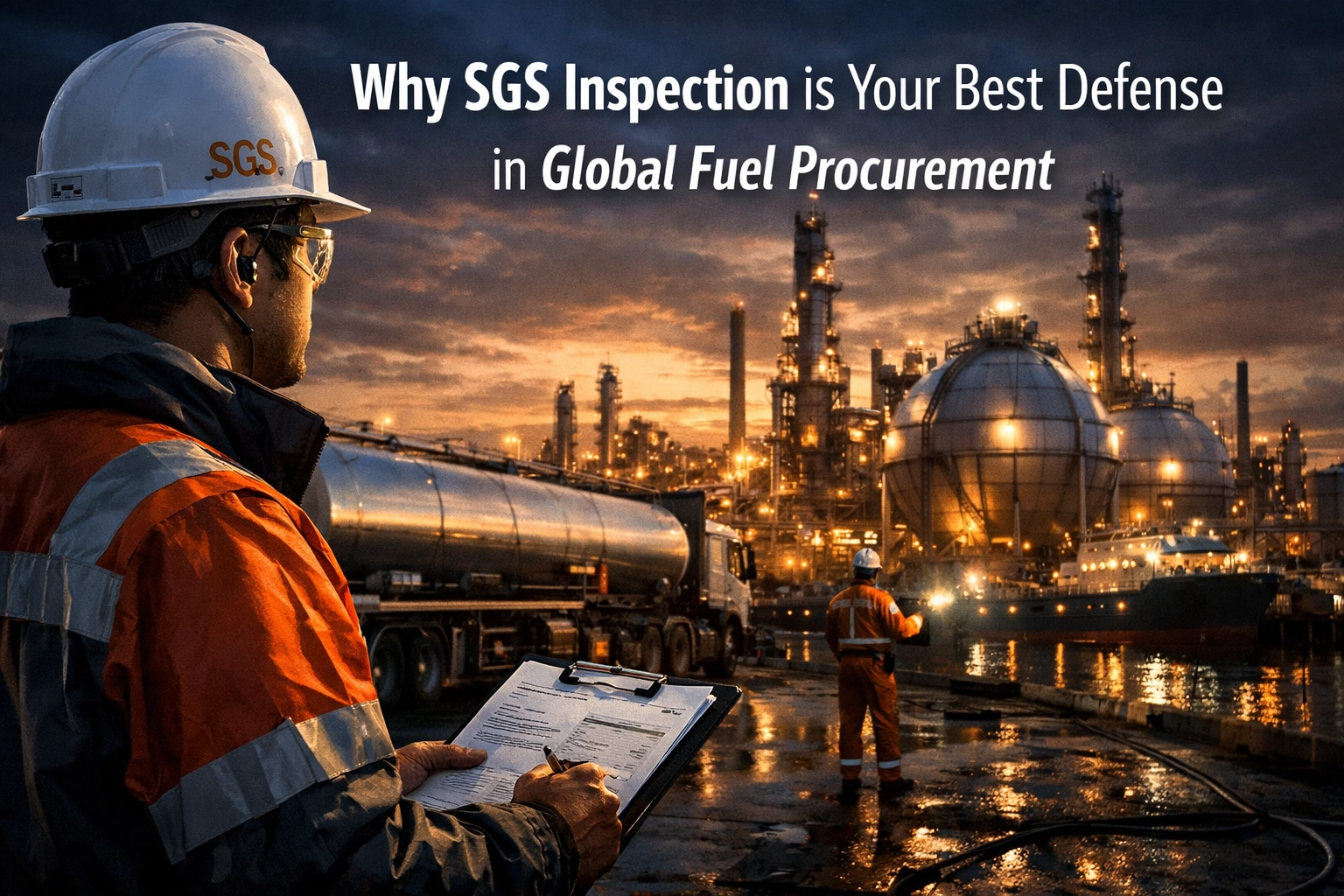
In global fuel procurement, a single bad cargo can cost millions. Engine damage, failed deliveries, compliance violations, and reputation loss: these aren't theoretical risks. They're daily realities for buyers who skip third-party verification. SGS inspection has become the industry standard for a reason: it's the only way to confirm what's actually in the tank before money changes hands.
Whether you're sourcing EN590 diesel or Jet Fuel A1, the question isn't whether you can afford third-party inspection. It's whether you can afford not to have it.
The Fundamental Problem with Self-Reported Quality
Here's what every fuel buyer learns eventually: seller-provided documentation means nothing without independent verification. Suppliers can produce impressive certificates, spec sheets, and quality declarations: all completely fabricated. The fuel market attracts sophisticated fraud operations that understand exactly what documents buyers expect to see.
Without SGS or equivalent third-party inspection, you're essentially taking a seller's word that their product meets specifications. In an industry where spot transactions often involve parties who've never met face-to-face, this approach is financial suicide.

The stakes are particularly high with EN590 diesel and Jet Fuel A1. These aren't commodity products where "close enough" works. Jet fuel that's even slightly off-spec can ground aircraft. Diesel that doesn't meet sulfur requirements can damage modern engines within hours and trigger massive regulatory penalties.
What SGS Inspection Actually Provides
SGS (Société Générale de Surveillance) operates as an independent third party with no financial interest in whether your transaction succeeds or fails. This neutrality is everything. When SGS certifies fuel quality, they're staking their global reputation on the accuracy of that assessment.
The company's Seal of Quality program, operational since 2003, creates a standardized framework for fuel quality monitoring. This isn't a one-time check: it's comprehensive verification throughout the supply chain, from storage facilities to final delivery points.
SGS inspection typically covers:
- Full specification testing against international standards (ASTM, ISO, API)
- Quantity verification to confirm actual volume matches documentation
- Certificate of Quality with detailed laboratory analysis
- Chain of custody documentation proving product integrity
- Real-time reporting accessible to all transaction parties
This level of verification eliminates the information asymmetry that fraudsters exploit. When both buyer and seller know an independent inspector will verify everything, bad actors simply move on to easier targets.
Supply Chain Visibility: The Multi-Point Protection System
One inspection at loading isn't enough. Professional fuel procurement requires verification at multiple supply chain stages. SGS provides quality checks at:
Terminal and depot levels – Confirming fuel meets specifications before it ever leaves storage. This catches issues with base product quality before anyone invests in transportation.
During transportation – Tanker truck inspections ensure nothing changes during transit. Contamination during transport is more common than buyers expect, particularly in regions with aging infrastructure.
At delivery points – Final verification that what arrives matches what was shipped. This protects against last-minute substitutions and ensures the fuel that enters your client's equipment meets every contractual specification.

This multi-stage approach matters because fuel quality can degrade or change at every handoff. A product might leave the refinery meeting specs but pick up water contamination during ship-to-shore transfer. It might meet specifications at the port but exceed sulfur limits after sitting in poorly maintained storage tanks.
Each verification point creates documented evidence of quality at that specific moment. If problems emerge, you know exactly where in the supply chain they occurred.
International Standards Compliance: Your Regulatory Shield
Global fuel trade involves navigating a maze of regulations that vary by country, region, and end-use application. SGS testing against international standards provides your compliance documentation for:
- ASTM D975 for diesel fuel specifications
- ASTM D1655 for aviation turbine fuels
- ISO 8217 for marine fuels
- EN 590 European diesel standards
- API specifications for various petroleum products
This standardization matters enormously for cross-border transactions. When SGS certifies your fuel meets ASTM D1655 specifications for Jet A1, customs officials and aviation authorities worldwide recognize that certification. You're not arguing about whether your fuel meets requirements: you're presenting documentation from a globally recognized authority.
The compliance value extends beyond customs clearance. Modern engine manufacturers often void warranties if operators use fuel that doesn't meet specific standards. SGS documentation proves you supplied compliant product, protecting you from warranty-related liability claims.
The Red Flags SGS Inspection Catches
Experienced fuel traders know the warning signs of problematic suppliers. SGS inspection typically exposes these issues before money changes hands:
Off-spec sulfur content – The most common problem with diesel. Sellers claim EN590 compliance (10 ppm sulfur maximum) while delivering product with 50 ppm or higher. SGS testing catches this immediately.
Water contamination – Can damage engines, promote microbial growth, and cause fuel system corrosion. Particularly common in aging storage facilities and inadequately maintained tanks.
Incorrect flash point – Critical for aviation fuel safety. Product marketed as Jet A1 might actually be a lower-grade kerosene blend with dangerous flash point characteristics.
Density and viscosity variations – Indicate product has been blended or diluted. Often signals that you're not receiving the pure grade you're paying for.
Contamination with other products – Storage tanks that previously held different fuels can contaminate current product. SGS testing identifies chemical signatures that indicate mixing.

These aren't minor technical details. Each represents a failure that can ground aircraft, damage equipment, trigger regulatory action, or breach contracts with downstream buyers. SGS inspection is your early warning system that prevents these failures from becoming your responsibility.
Why Third-Party Verification Is Non-Negotiable
The fuel trade operates on trust, but trust requires verification. In 2026's global energy market, no serious buyer accepts self-certified quality claims. The risks are too high and the fraud too sophisticated.
Consider the typical fraud scenario: a seller provides impressive documentation: certificates of analysis, quality reports, even photos of product in tanks. Everything looks legitimate. You wire payment. Then the fuel either never ships, or it arrives severely off-spec. By the time you discover the problem, the seller has disappeared and your money is gone.
SGS inspection breaks this fraud model because it requires physical verification by an independent party before payment releases. The inspector actually visits the facility, draws samples, conducts testing, and confirms the product exists and meets specifications. This simple step eliminates the vast majority of procurement fraud.
Beyond fraud prevention, SGS provides legal protection. When disputes arise: and in global fuel trading, they will: SGS documentation establishes the facts. Their reports detail exactly what was tested, when, where, and what the results showed. This evidence often determines outcomes in arbitration and litigation.
The Cost-Benefit Reality
Some buyers balk at inspection costs, viewing them as unnecessary expense. This perspective ignores basic risk mathematics. SGS inspection typically costs $2,000-$5,000 depending on location and scope. A single cargo of fraudulent or off-spec fuel can cost hundreds of thousands or millions in losses, legal fees, and reputation damage.
The question isn't whether inspection adds cost. It's whether that cost is negligible compared to the risks it prevents. For any transaction involving significant volume or value, the answer is obvious.
Professional buyers build inspection costs into their pricing models. It's not an extra expense: it's a fundamental cost of doing business properly, like insurance or legal review.
Moving Forward with Confidence
Global fuel procurement doesn't have to be a gamble. Third-party inspection transforms it from a trust exercise into a verified transaction where both parties operate with confirmed information. SGS provides the verification infrastructure that makes professional fuel trading possible.
At Van Dyke Energy, we structure every EN590 and Jet Fuel A1 transaction around independent verification. It's not optional, and it's not negotiable. It's how you protect your business, your clients, and your reputation in a market where mistakes are catastrophic.
If you're evaluating suppliers or structuring new procurement relationships, make SGS inspection a non-negotiable requirement. Sellers who resist third-party verification are telling you everything you need to know about their intentions.
Mark Van Dyke
Founder & CEO at VanDykeEnergy.com