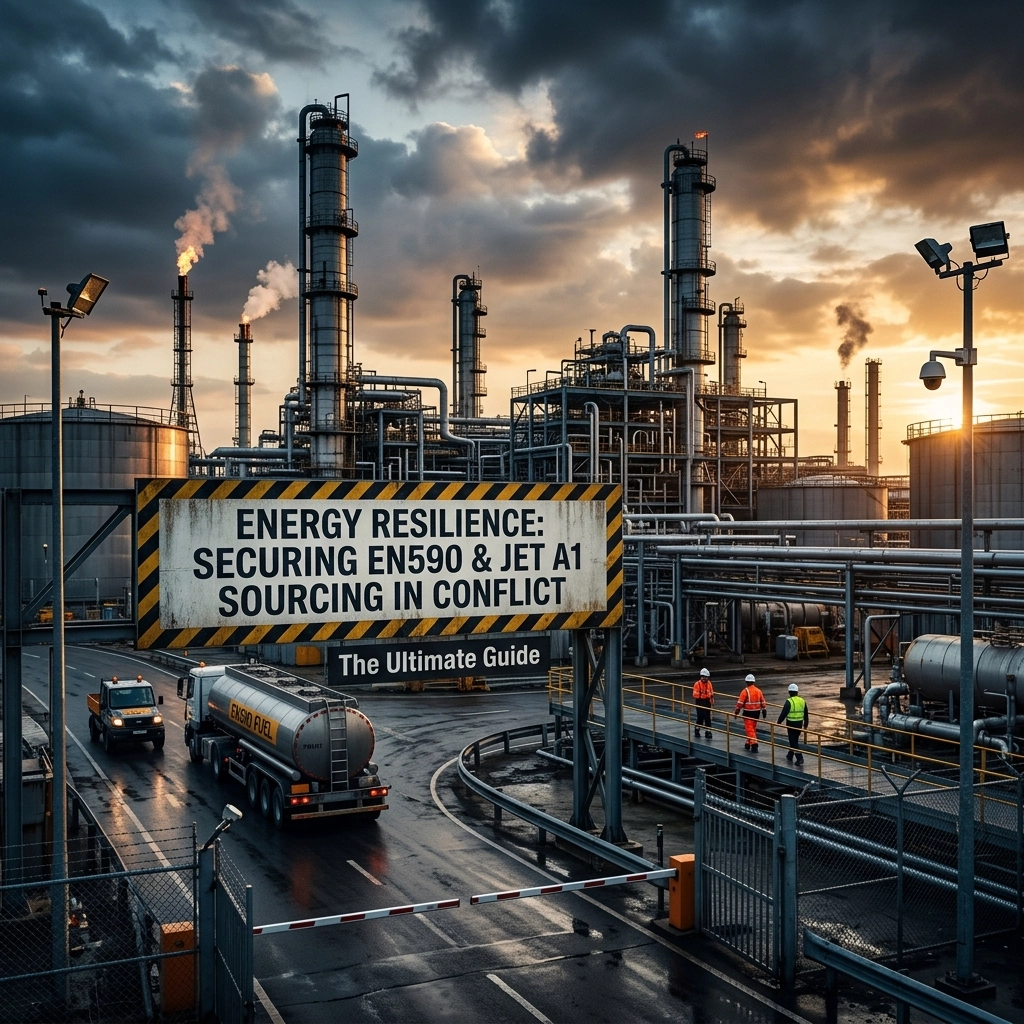
The global energy landscape shifted fundamentally on February 28, 2026. As the conflict in Iran escalated, the secondary effects rippled through the world’s most critical maritime arteries, leaving fuel buyers and industrial stakeholders in a state of high alert. In today’s climate, energy resilience is no longer a corporate buzzword; it is a survival mandate for any organization dependent on EN590 diesel, Jet Fuel A1, or D6 Virgin Fuel Oil.
As of May 1, 2026, the volatility in the Middle East has moved beyond mere price speculation into the realm of physical supply risk. For the modern procurement officer, the challenge is twofold: navigating a market where the Strait of Hormuz is effectively throttled and avoiding the surge of opportunistic fraud that thrives in regional instability. At Van Dyke Energy, we recognize that reliability is the only currency that matters when the traditional supply chain breaks down.
The Strait of Hormuz Stranglehold: A Logistics Crisis
The Strait of Hormuz remains the world’s most significant oil transit chokepoint. Historically, it carried approximately 20% of the global oil supply. However, since the escalation in late February, tanker traffic has seen a catastrophic collapse of nearly 70–80%. This bottleneck has forced the global fleet to reroute around the Cape of Good Hope, adding weeks to delivery schedules and sending war-risk insurance premiums into the stratosphere.

For those sourcing Jet Fuel A1 and EN590, this disruption means that "business as usual" is over. European markets are particularly exposed, with nearly 30% of their jet fuel demand traditionally met by Persian Gulf exports. With Northwest European jet fuel differentials hitting record highs: upwards of $355 per metric ton over gasoil futures: the cost of inaction is staggering.
Van Dyke Energy has spent years building a logistics network that does not rely on a single geographical point of failure. Our ability to move refined fuels worldwide despite regional instability stems from a diversified portfolio of non-sanctioned refineries and a vetted network of logistics partners who understand the nuances of midstream movement in high-threat environments.
Jet Fuel A1: High-Stakes Procurement in a Tight Market
The aviation sector is currently facing its most acute supply crisis in decades. Unlike diesel, which has broader storage options, Jet Fuel A1 infrastructure is specialized and currently under immense strain. Commercial inventories in Europe typically cover only about one month of demand, creating a razor-thin margin for error.
When sourcing Jet Fuel A1 during active conflict, several factors are non-negotiable:
- Stringent Quality Verification: Adherence to ASTM D1655 and DEF STAN 91-091 is mandatory. In a supply-starved market, the temptation to accept "off-spec" product is high, but the operational consequences for turbine engines are terminal.
- Proof of Product (POP) Authenticity: With fraud rates for Jet A1 estimated as high as 78% globally, buyers must demand rigorous proof of product.
- Logistics Redundancy: Relying on a single shipping route is a recipe for a grounded fleet. Energy resilience requires a mix of FOB (Free on Board) and CIF (Cost, Insurance, and Freight) contracts to balance risk.
The current market tightness is exacerbated by the fact that jet fuel has fewer specialized tanks available compared to diesel. Van Dyke Energy leverages deep-water port access and pre-allocated tankage to ensure our clients are not left waiting for a spot that may never open.
EN590 Diesel: The Foundation of Industrial Resilience
While the aviation sector struggles, the demand for EN590 10ppm ultra-low sulfur diesel has surged as industries seek to build strategic reserves. As the most traded refined product globally, EN590 offers more diversified sourcing options, but it is not immune to the Iranian conflict’s fallout.

The primary risk for an EN590 fuel buyer today is not just the price, but the legitimacy of the supply chain. Conflict zones often provide cover for "blended" products from sanctioned vs. non-sanctioned refineries. Entering into a contract with a sanctioned entity: even inadvertently: can lead to severe legal repercussions and the freezing of corporate assets by international regulators.
Red Flags in EN590 Sourcing:
- Unrealistic Pricing: If the offer is significantly below the current Platts Mediterranean or Rotterdam benchmarks, the product is likely non-existent or sanctioned.
- Vague Logistics: Sellers who cannot provide a clear Vessel Tracking Report or Tank Storage Receipt (TSR) are a high-risk liability.
- Pressure to Skip Due Diligence: The "urgent" nature of the conflict is often used by scammers to bypass standard vetting procedures.
Energy resilience requires a disciplined approach to the 7 mistakes you’re making with EN590 diesel procurement. At Van Dyke Energy, we provide a transparent, document-heavy process that ensures every drop of fuel is fully compliant and legally exportable.
Compliance as a Competitive Advantage
In a world of sanctions and "dark fleets," compliance is your strongest shield. The geopolitical instability in Iran has triggered a wave of new regulatory oversight. Navigating this requires more than just a legal team; it requires a compliance manager who lives and breathes international energy law.

We operate with a "compliance-first" mindset. This means:
- KYC/AML Excellence: We perform exhaustive "Know Your Customer" and "Anti-Money Laundering" checks on every entity in our chain.
- Top-Tier Banking: We understand why top 50 global banks matter when handling SBLCs and DLCs. If the bank won't touch the deal, neither will we.
- Third-Party Inspection: Every transaction involves reputable inspectors like SGS or Intertek to verify Quality & Quantity (Q&Q).
Reliability in 2026 is built on a foundation of vetted networks. Our sellers are not "ghost refineries"; they are established producers with a track record of performance even in high-volatility environments.
The Role of Logistics Expertise in Times of War
Moving fuel during a regional conflict is a chess game. With the Strait of Hormuz seeing a 70–80% traffic collapse, the "standard" routes are no longer viable for many. This is where Van Dyke Energy's logistics expertise provides a critical edge.

We focus on mission-critical fuel delivery. Whether it is rerouting a cargo of D6 to a safer port or securing a spot-buy of Jet Fuel A1 for an emergency aviation contract, our team monitors global shipping lanes in real-time. We account for the rising cost of freight and the extended lead times of the Cape of Good Hope route, ensuring our clients' supply chains remain uninterrupted.
For government and industrial clients, we offer the certainty that their fuel will arrive on time and on-spec. In a market defined by uncertainty, having a partner who can navigate the complexities of global trade: including the reshaping of oil and gas by trade wars: is indispensable.
Building Your Energy Resilience Strategy
To succeed as a fuel buyer in the current landscape, you must move beyond tactical purchasing and toward strategic energy resilience. This involves:
- Diversifying Supply Sources: Never rely on a single refinery or a single geographic region.
- Maintaining Strategic Reserves: In May 2026, an inventory buffer of at least 45–60 days is recommended for critical operations.
- Formalizing Procurement: Use structured processes like the Fuel Buyer RFP to attract verified, high-capacity sellers.
- Leveraging AI and Data: Stay ahead of market shifts by understanding the latest AI developments in oil and gas that predict logistics bottlenecks before they happen.

The conflict in Iran has highlighted the fragility of the global energy system. However, for those who partner with an expert who understands the intersection of geopolitics, logistics, and compliance, it also presents an opportunity to build a more robust and resilient operation.
Van Dyke Energy remains committed to redefining global oil and gas through transparency and trust. As we navigate the challenges of 2026 together, our focus remains on ensuring that your energy needs are met with the highest standards of reliability and professionalism.
Mark Van Dyke
Sales Director, VanDykeEnergy.com
Reliability Powered by Trust.