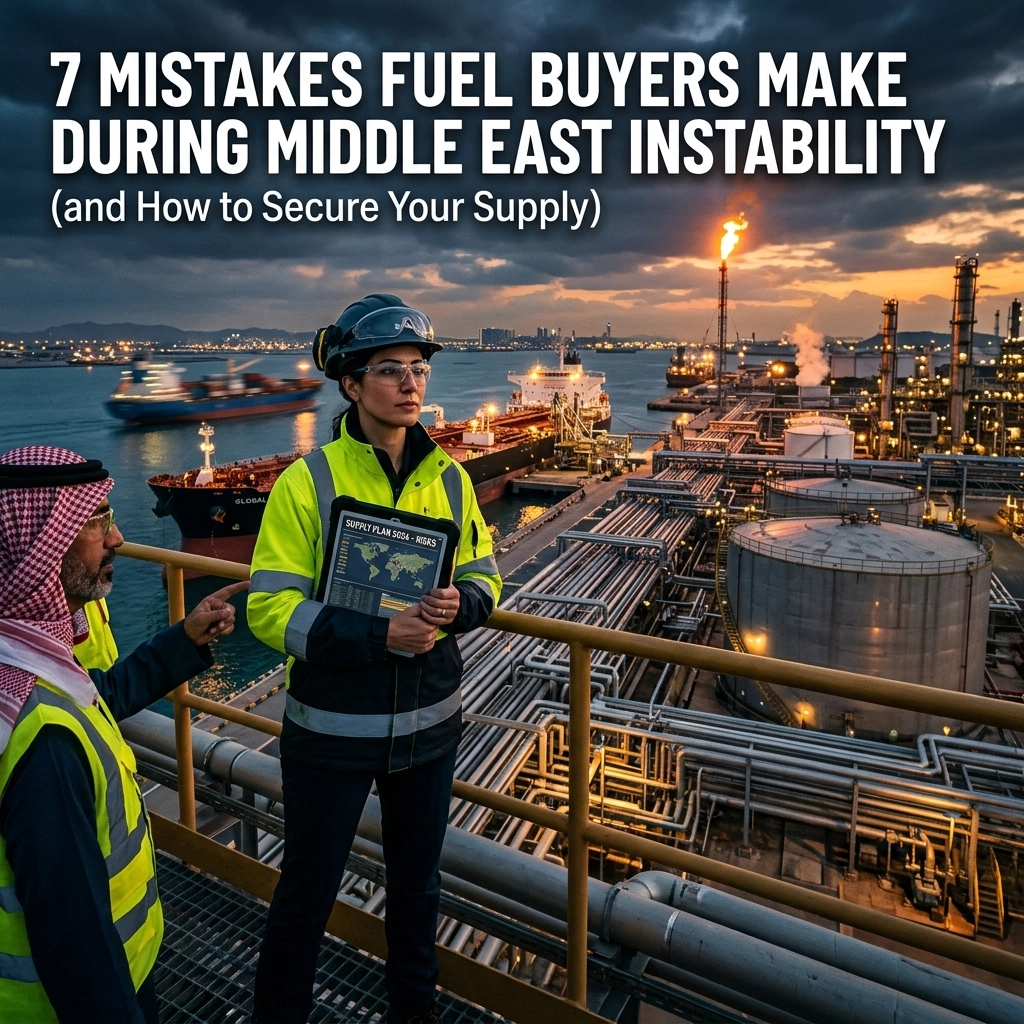
The global energy landscape is currently navigating one of its most volatile periods in recent history. As of April 2026, the ongoing conflict involving Iran and the surrounding regional powers has sent ripples through the oil and gas sector that extend far beyond the Persian Gulf. For the modern fuel buyer, the "business as usual" approach is no longer an option. The heightened risk in the Strait of Hormuz: a chokepoint responsible for nearly 20% of the world’s liquid petroleum consumption: means that procurement strategies must evolve from simple cost-minimization to high-stakes energy resilience.
When regional instability peaks, the market becomes flooded with two things: extreme price volatility and opportunistic bad actors. Securing reliable volumes of EN590, Jet Fuel A1, and D6 requires more than just a large bank balance; it requires a sophisticated understanding of logistics, compliance, and geopolitical maneuvering.
At Van Dyke Energy, we have spent years building a vetted network designed to withstand these exact scenarios. However, many buyers still fall into predictable traps that lead to lost capital, legal entanglements, or dry tanks.
Here are the seven most common mistakes fuel buyers make during Middle East instability and how you can avoid them to secure your supply.
1. Chasing "Ghost Tenders" and Unrealistic Pricing
In times of crisis, the "risk premium" on oil naturally increases. A common mistake for an inexperienced fuel buyer is attempting to find pre-conflict pricing in a post-conflict market. Scammers and unreputable brokers often use Middle East instability as a smokescreen, offering "discounted" EN590 or Jet Fuel A1 supposedly held in "distressed" storage.
The Reality: During regional conflict, real fuel is a premium asset. If a price seems too good to be true while the rest of the market is spiking, it is almost certainly a scam. Authentic suppliers like Van Dyke Energy provide transparent, market-indexed pricing that reflects the current reality of the global supply chain. Relying on transparent fuel trading is the only way to ensure you are transacting for real product.
2. Underestimating Logistics Friction and Insurance Spikes
Instability in the Middle East doesn't just affect production; it weaponizes logistics. During the current Iran conflict, shipping lanes have become high-risk zones, leading to a massive surge in War Risk Insurance premiums. Many buyers calculate their landed costs based on outdated freight rates, only to find their margins evaporated by the time the vessel reaches the discharge port.

Van Dyke Energy’s logistics expertise is our primary differentiator. We maintain a vetted network of shipping partners who are equipped to handle high-risk transits. Whether we are moving D6 fuel or specialized aviation kerosene, we account for rerouting, increased bunker fuel costs, and insurance fluctuations before the contract is signed.
3. Neglecting Sanction Compliance and Origin Vetting
As the conflict with Iran intensifies, the international community frequently updates sanction lists. One of the most dangerous mistakes a buyer can make is failing to conduct deep-level due diligence on the origin of their fuel. Proscribed regimes often attempt to "blend" or "re-flag" crude and refined products to bypass trade restrictions.
Working with Van Dyke Energy ensures that your supply chain remains strictly within the bounds of international law. We prioritize sanctioned vs non-sanctioned refinery clarity, ensuring that every drop of EN590 or Jet Fuel A1 we deliver is fully compliant with US and EU regulations. Falling foul of OFAC (Office of Foreign Assets Control) can lead to seized assets and permanent corporate blacklisting.
4. Over-Reliance on Single-Sourced Supply Chains
Buyers who rely exclusively on Middle Eastern refineries often find themselves in a "force majeure" nightmare when kinetic conflict disrupts operations. Energy resilience is built on diversification. If your supply of D6 or Jet Fuel A1 is tied to a single terminal in a volatile region, your entire operation is at the mercy of the next headline.
We mitigate this risk by maintaining a global footprint. While we respect the Middle East's role in energy, our logistics network spans across multiple continents, allowing us to pivot supply routes when regional instability makes certain hubs untenable.
5. Failing to Secure High-Tier Financial Instruments
In a volatile market, refineries and sellers are risk-averse. Many buyers lose out on allocations because they attempt to use weak financial instruments from low-tier or "offshore" banks. During Middle East instability, the importance of why top 50 global banks matter cannot be overstated.

A Standby Letter of Credit (SBLC) or Documentary Letter of Credit (DLC) from a top-tier institution acts as a universal language of trust. At Van Dyke Energy, we require and facilitate structured financial compliance to ensure that when a vessel is loaded, there are no payment disputes that could cause a delivery delay in a high-risk environment.
6. Compromising on Quality Specifications in the Rush to Buy
When supply is tight, there is a temptation to "take what you can get." However, modern engines and turbines are calibrated for specific standards. Accepting a "close enough" version of EN590 (10PPM Diesel) can lead to catastrophic mechanical failure in your fleet or industrial equipment.
Our commitment to reliability means that every transaction involves rigorous inspection protocols. We do not skip steps. Whether it is a Proof of Product (POP) or a fresh SGS report at the port of loading, we ensure that the Jet Fuel A1 or D6 you ordered meets the exact chemical profile required for your operations.
7. Working with Unvetted Intermediaries
The most common mistake: and the most costly: is working through a "daisy chain" of unvetted brokers who have no direct relationship with the seller or the fuel. In a crisis, these chains break instantly. The intermediaries disappear, and the buyer is left with no fuel and a legal mess.
Van Dyke Energy operates as a direct link in the energy chain. We represent a vetted network of sellers and provide a streamlined RFP process for buyers. By removing the "noise" of unverified middlemen, we provide a clear, professional path to procurement.

How Van Dyke Energy Secures Your Supply
The conflict in Iran and the broader Middle East is a reminder that the energy market is fundamentally a geopolitical market. To succeed as a fuel buyer in 2026, you need a partner that understands the intersection of global politics, maritime logistics, and financial compliance.
Van Dyke Energy offers:
- Logistics Expertise: We navigate the complexities of high-risk shipping routes to ensure your EN590 and Jet Fuel A1 arrive on time.
- Compliance-First Approach: Our vetting processes protect you from the legal risks of sanctioned products.
- Verified Network: We only work with refineries and storage facilities that meet our rigorous standards for quality and reliability.
- Global Reach: We diversify your supply options to ensure that regional instability in one area doesn't halt your entire operation.
In today’s climate, energy resilience is not a luxury; it is a prerequisite for survival. By avoiding these seven common mistakes and partnering with a firm that prioritizes trust and professional execution, you can secure your supply and protect your bottom line.

Securing fuel in a volatile market requires a steady hand and an expert network. At Van Dyke Energy, we provide both. If you are ready to stabilize your procurement process and move away from the uncertainty of unverified markets, contact us today.
Mark Van Dyke
Sales Director, VanDykeEnergy.com
Reliability Powered by Trust.