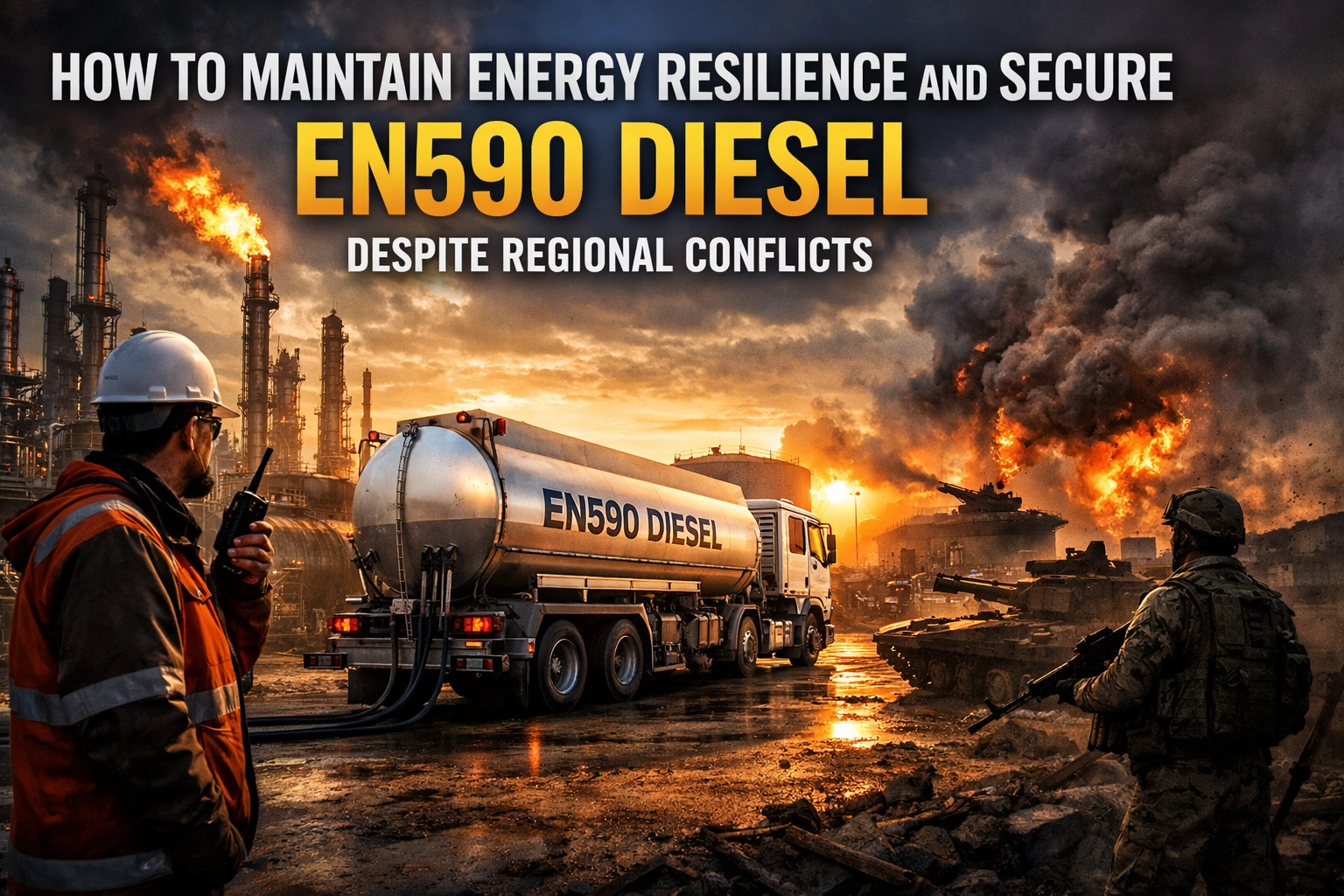
In the current geopolitical landscape of March 2026, the global energy market is facing one of its most rigorous tests in decades. As regional conflicts, specifically the ongoing instability in and around Iran, continue to disrupt traditional supply routes, the role of a sophisticated fuel buyer has shifted from simple procurement to strategic risk management. Maintaining energy resilience is no longer a luxury; it is a fundamental requirement for industrial survival.
For organizations relying on EN590 diesel, Jet Fuel A1, and D6 virgin fuel oil, the volatility in the Middle East has created a "new normal" characterized by price fluctuations and logistical bottlenecks. However, even in this climate, fuel procurement remains possible for those who understand how to navigate the complexities of international logistics and vetted supplier networks.
The Impact of Regional Conflict on Global Distillates
The Middle East remains the heartbeat of global energy production. When regional tensions escalate: as we are currently witnessing in Iran: the ripples are felt immediately in the Mediterranean and Northwest European markets. The primary concern for a fuel buyer today isn't just the price per barrel, but the physical delivery of refined products through contested maritime corridors.
Conflict in this region often leads to:
- Increased Freight and Insurance Premiums: War risk surcharges can double the cost of shipping overnight.
- Supply Chain Diversion: Vessels are forced to take longer routes (such as around the Cape of Good Hope), delaying EN590 deliveries by weeks.
- Refinery Constraints: Regional instability often limits the production capacity of local refineries, forcing buyers to look toward the U.S. or alternative European hubs.
At Van Dyke Energy, we have optimized our operations to mitigate these specific risks. By leveraging a global footprint, we ensure that our clients are not overly exposed to a single geographical point of failure.

Securing EN590: Why Logistics Expertise is the Ultimate Safeguard
EN590 10PPM is the backbone of European and international transport. In times of conflict, the demand for high-quality, low-sulfur diesel spikes as nations bolster their strategic reserves. To secure these volumes, you need more than just a contract; you need a logistics powerhouse that understands the nuances of FOB (Free on Board) and CIF (Cost, Insurance, and Freight) movements in high-risk zones.
Energy resilience is built on the ability to pivot. If a traditional port of loading becomes a "no-go" zone due to regional strikes or blockades, your supplier must have the capacity to re-route product or tap into secondary storage facilities. Van Dyke Energy maintains deep relationships with major storage terminals and vetted shipping lines to ensure that Jet Fuel A1 and EN590 continue to flow, regardless of the headlines.
For more information on how we manage these complex transactions, visit our About Us page.
Identifying Red Flags: Procurement Risks in a Volatile Market
Whenever there is a crisis in the energy sector, "bad actors" emerge. These are often intermediaries claiming to have access to millions of metric tons of product at "discounted" prices. In 2026, the sophistication of these scams has increased. Every serious fuel buyer must be vigilant.
Common Red Flags to Watch For:
- Unrealistic Discounts: If the price for EN590 is significantly below the current Platts benchmark despite the Iran conflict driving prices up, it is likely a fraud attempt.
- Pressure to Bypass Due Diligence: Scammers often use "regional urgency" as an excuse to skip standard KYC (Know Your Customer) or AML (Anti-Money Laundering) procedures.
- Invalid Proof of Product (POP): During conflicts, many claim to have "allocation" from state-owned refineries that they cannot prove. Understanding what constitutes a real POP is critical.

We recommend all our partners read our guide on what every fuel buyer should know about POP to protect their capital and their reputation.
The Role of Vetted Networks and Financial Instruments
In a high-risk environment, the "Who" is just as important as the "What." Van Dyke Energy operates through a meticulously vetted network of producers, shippers, and financial institutions. In today’s market, the strength of your banking relationships dictates the speed of your trade.
The use of SBLCs (Standby Letters of Credit) and DLCs (Documentary Letters of Credit) from Top 50 Global Banks is non-negotiable for securing large-scale shipments of Jet Fuel A1 or D6. These instruments provide the necessary security for both the buyer and the seller, ensuring that funds are only released upon successful delivery and inspection by independent bodies like SGS or Saybolt.
To understand why your choice of bank matters so much in the current climate, explore our analysis on why top 50 global banks matter in fuel trade.
Maintaining Resilience: A Checklist for the Modern Fuel Buyer
To ensure your operations remain uninterrupted by the regional conflicts in the Middle East, consider adopting the following strategies:
- Diversify Supply Origins: Do not rely solely on Middle Eastern exports. Look toward U.S. Gulf Coast or Asian refined products when the Strait of Hormuz is under threat.
- Secure Longer-Term Contracts: While the spot market offers flexibility, term contracts (12-month R&E) provide a level of price and volume stability that is invaluable during periods of war.
- Validate the Logistics Chain: Ensure your seller has a proven track record of moving product. Ask for redacted Bill of Ladings or track records of successful discharges in the last 6 months.
- Focus on Compliance: Ensure every transaction follows strict Terms and Conditions. Compliance is your best defense against secondary sanctions or legal entanglements arising from regional conflicts.

Moving Beyond Diesel: Jet Fuel A1 and D6 Resilience
While EN590 is a primary focus for many, the aviation and power generation sectors face similar pressures. Jet Fuel A1 is highly sensitive to geopolitical shocks. As commercial and military flight paths are rerouted to avoid conflict zones, the demand for refueling at "safe" hubs increases exponentially.
Similarly, D6 Virgin Fuel Oil remains a critical component for power plants and heavy industry. Ensuring a steady supply of D6 requires a logistics partner who can manage the massive tankers (VLCCs) required for these movements. Van Dyke Energy’s expertise extends across the entire refined spectrum, ensuring that whether you are fueling a fleet of aircraft or a national power grid, your supply remains secure.
The Van Dyke Energy Commitment
In today's climate, trust is the only currency that doesn't depreciate. At Van Dyke Energy, we pride ourselves on being a beacon of reliability in an industry often clouded by uncertainty. Our logistics expertise allows us to move EN590, Jet Fuel A1, and D6 worldwide, overcoming the hurdles presented by regional instability and political friction.
We invite serious buyers to review our FAQ or reach out to us directly through our Buyers Portal to discuss how we can support your energy requirements during these challenging times.
Authoritative Conclusion
The conflict in Iran and the broader regional instability are significant challenges, but they are not insurmountable. Energy resilience is achieved through a combination of rigorous compliance, sophisticated logistics, and a commitment to transparency. By partnering with an entity that understands the intricacies of the global fuel market, you can secure your supply chains and protect your organization from the volatility of 2026.
Securing EN590 or Jet Fuel A1 is no longer just a transaction: it is a strategic operation. Ensure you have the right team on your side.

Mark Van Dyke
Sales Director, VanDykeEnergy.com
Reliability Powered by Trust.
For further insights into fuel procurement strategies, check out our post on 7 mistakes you’re making with EN590 diesel procurement or contact us today to speak with a logistics expert.